


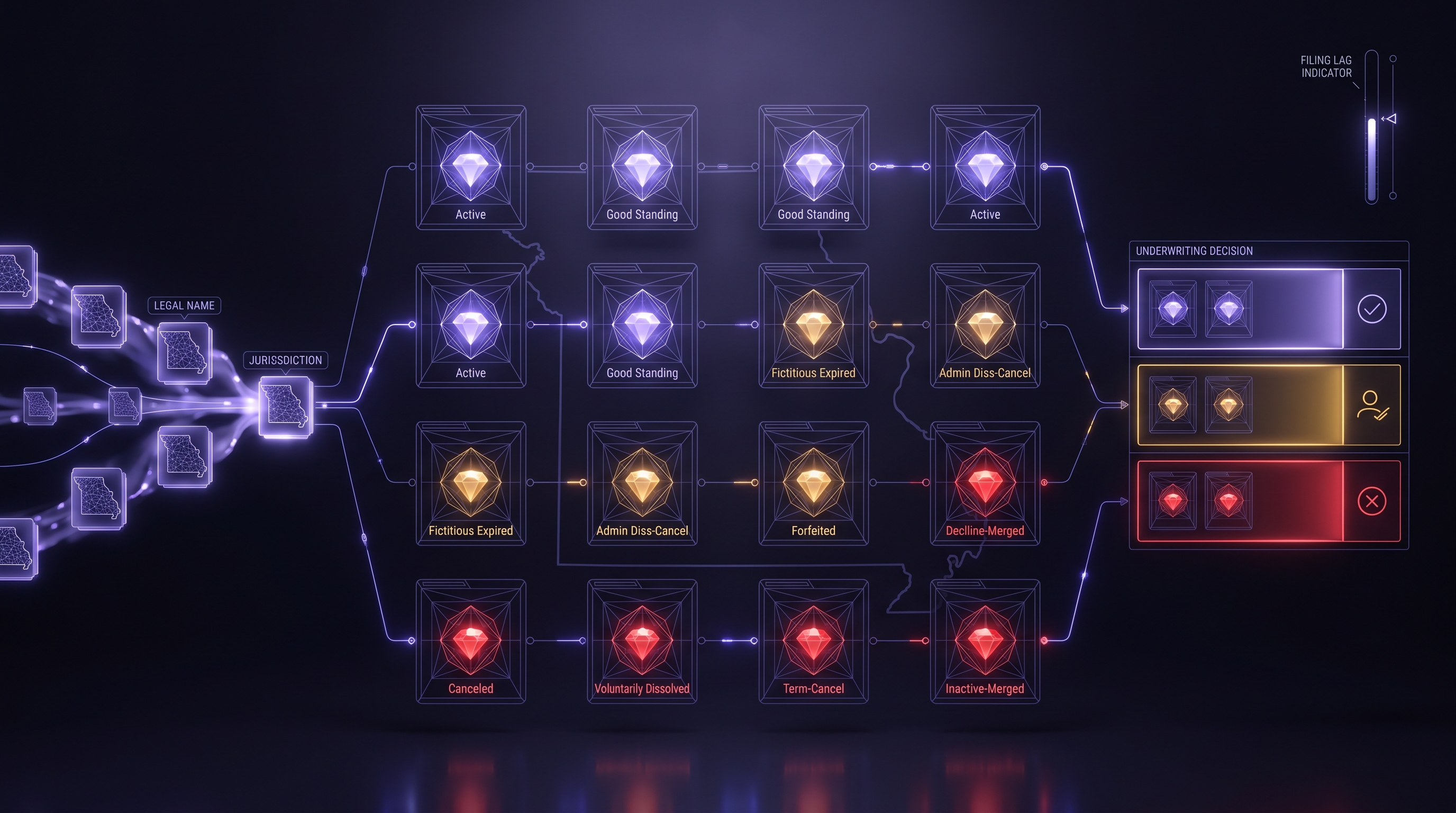
Executive Summary: Missouri's Secretary of State tracks 13 distinct entity statuses across LLCs, corporations, nonprofits, and fictitious name filings. For alternative lenders underwriting Missouri borrowers, those status codes are the first signal of whether a business is legally operating, administratively impaired, or quietly wound down months before the loan application landed on your desk. This guide breaks down each status, maps it to an underwriting decision, compares Missouri's system to California, Texas, and Florida, and flags the limitations of Missouri's public filing data that lenders need to account for in their verification stack.
Why Do Business Entity Statuses Matter to Alternative Lenders Underwriting in Missouri?
Entity status is a compact signal of three things at once: whether the business is in compliance with state filing requirements, whether it retains its liability shield, and whether it can legally enter into a funding contract. Missing any of the three is an avoidable loss event for a merchant cash advance provider, an invoice factor, or an equipment lender.
Missouri had roughly 575,000 active business entities on file with the Secretary of State as of late 2024, and processed more than 60,000 new entity filings that year.[1] Of those active entities, a material share cycle through administrative dissolution each year for failure to file annual reports or maintain a registered agent on record. A borrower can remain operationally active (taking payments, running payroll) while technically stripped of its liability shield. Chapter 347 of the Missouri Revised Statutes explicitly provides that a dissolved LLC "continues its existence but may not carry on any business except that necessary to wind up and liquidate its affairs."[2]
For alternative lenders, three underwriting pressure points make Missouri entity status checks non-negotiable:
• Liability shield verification. Funding a dissolved LLC can expose the lender to pierced-veil arguments if the member personally guaranteed the debt and the dissolution undermines the separation of entity and individual.[3]
• Lien priority and UCC filing validity. UCC-1 filings against a dissolved entity remain enforceable in Missouri, but competing claims from creditors of a successor entity, a resurrected LLC, or personal assets of the former members create priority disputes that slow recovery.[4]
• Stacking and shell company detection. Missouri has been cited in fraud advisories as a jurisdiction where shell LLCs with minimal filing requirements can be used to layer multiple MCA advances.[5]
"The single most common underwriting mistake we see on Missouri files is treating 'Active' and 'Good Standing' as synonymous. They are not. A status-level check that stops at 'Active' misses the compliance question entirely." Industry observation from SOS data vendors cited in a 2025 SFNet risk briefing.[6]
The practical consequence: a one-line "business verified" field in your loan management system is insufficient for Missouri. The status itself carries three separate data points (legal existence, compliance posture, operational restriction) that need to route to different parts of the underwriting workflow.
What Are Missouri's 13 Business Entity Statuses?
Missouri's Secretary of State publishes entity status through its Business Entity Search portal and its bulk data exports. The 13 statuses fall into four functional groups: active operational statuses, administrative impairment statuses, dissolution statuses, and fictitious name filings. Each group carries a different underwriting implication.
Active Operational Statuses
• Active. The entity is currently registered and has filed its most recent required reports. This is the baseline "okay to proceed" status, but it does not confirm good standing for every purpose. An Active entity may still owe franchise tax, may still have a lapsed registered agent notice pending, or may be in an early warning window before administrative dissolution.
• Good Standing. A stricter subset of Active. The entity is current on all filings, has a registered agent on record, and is eligible to receive a Certificate of Good Standing from the Secretary of State. Missouri loan documents that reference "good standing" as a representation typically require this specific status, not merely "Active."[7]
• Fictitious Active. A registered fictitious name (DBA) filing that is currently valid. Fictitious filings in Missouri have a five-year duration and must be renewed; an active filing means the "doing business as" name is lawfully claimed by the registered entity.[8]
Administrative Impairment Statuses
• Admin Diss/Cancel - Report. The entity was administratively dissolved or canceled by the Secretary of State for failure to file a required annual report or biennial registration. In Missouri, LLCs are not required to file annual reports (a key departure from most states), but corporations and nonprofits are, and failure triggers this status after a statutory cure period.[9]
• Admin Diss/Cancel - Agent. The entity was administratively dissolved or canceled for failure to maintain a registered agent on record. This is a procedural failure rather than an operational one, but it still strips the liability shield and makes the entity non-compliant. Missouri gives 60 days' notice before this status is applied.[10]
• Forfeited. Used primarily for foreign (out-of-state) entities that fail to maintain their Missouri registration, and occasionally for domestic entities with tax-related filing failures referred by the Department of Revenue. A forfeited entity cannot legally conduct business in Missouri until reinstatement.
Dissolution Statuses
• Voluntarily Dissolved. The members, shareholders, or directors formally voted to dissolve the entity and filed Articles of Dissolution or Termination. This is the cleanest dissolution path and typically signals an orderly wind-down. The entity may continue to exist for winding up purposes (collecting receivables, paying creditors, distributing remaining assets) for a period after the filing date.
• Canceled. A broad status used for LLCs and similar entities that have been formally dissolved through filing a Certificate of Cancellation. Functionally similar to Voluntarily Dissolved but applied to the LLC structure, which Missouri statutes treat separately from corporate dissolution under Chapter 347.[2]
• Term/Cancel. Applied to entities that have reached their stated term of existence (rare in Missouri, where most LLCs elect perpetual duration) or have been otherwise formally terminated. Often seen on older corporate filings from before the 1990s.
• Dissolved Nonprofit. A specialized dissolution status for 501(c) nonprofit corporations registered in Missouri. Used when the nonprofit has filed Articles of Dissolution and completed its wind-up process. Different statutory framework under Chapter 355.[11]
• Withdrawn. Applied to foreign entities (organized in another state, registered to do business in Missouri) that have filed a formal withdrawal of their Missouri registration. The entity may continue to exist in its home state; it is no longer authorized to conduct business in Missouri.
• Inactive - Merged. The entity no longer exists as a separate legal person because it was merged into another entity. The surviving entity inherits the merged entity's rights, obligations, and, in most cases, its debts. For lenders, this is the status that most often requires a call to the successor entity before funding or before enforcement.
Fictitious Name Statuses
• Fictitious Expired. A fictitious name (DBA) registration that has lapsed. In Missouri, fictitious names require renewal every five years. An expired fictitious name does not automatically invalidate contracts signed under that name, but it creates documentation friction and may be used by a defaulting borrower as an argument for contract unenforceability.[8]
This 13-status schema is more granular than most states publish publicly. California, by comparison, uses 7 primary statuses; Florida uses 9.[12]
How Does Each Status Translate to an Underwriting Decision?
Status-to-decision mapping is where most automated verification stacks break down. "Active" is not an approval. "Voluntarily Dissolved" is not always a hard decline (think of refinancing a wind-down, or collecting against a former member's personal guarantee). The table below summarizes how a working alternative lender underwriting desk typically routes each Missouri status.
| Missouri Status | Underwriting Action | Secondary Verification Required |
|---|---|---|
| Active | Proceed, but verify Good Standing separately before funding | Request Certificate of Good Standing or run a secondary API check |
| Good Standing | Proceed to next underwriting stage | None (for entity-level check) |
| Fictitious Active | Verify the parent entity status; fictitious name alone is not the borrower | Pull registered entity record |
| Admin Diss/Cancel - Report | Decline or condition on reinstatement proof | Request filed reinstatement documents |
| Admin Diss/Cancel - Agent | Decline or condition on agent reinstatement | Request updated registered agent filing |
| Forfeited | Decline | N/A for new origination; collection may still proceed |
| Voluntarily Dissolved | Decline new funding; evaluate wind-down exposure | Check for successor entity or PG enforceability |
| Canceled | Decline | Same as Voluntarily Dissolved |
| Term/Cancel | Decline; investigate successor or revival | Manual SOS search on related entities |
| Dissolved Nonprofit | Decline; nonprofit structure rarely matches alt lending ICP anyway | N/A |
| Withdrawn | Decline Missouri-based funding; home-state verification required | Query home state SOS |
| Inactive - Merged | Route to successor entity; do not fund the merged entity | Pull successor entity record and UCC history |
| Fictitious Expired | Condition on renewal; verify underlying entity is Active | Pull parent entity record |
The pattern that matters most: five of the 13 statuses (Admin Diss/Cancel - Report, Admin Diss/Cancel - Agent, Forfeited, Term/Cancel, Fictitious Expired) are conditional rather than binary. They support funding only if the borrower cures the underlying issue and provides documentation. A workflow that treats these as automatic declines loses good deals. A workflow that treats them as Active is funding impaired borrowers.
This is why alternative lenders benefit from pairing SOS status checks with a secondary verification layer such as an EIN verification placed in the correct underwriting waterfall and UCC filing search, rather than relying on the SOS status field alone.
How Does Missouri's System Compare to California, Texas, and Florida?
Alternative lenders operating across multiple states need to normalize status definitions because each state uses different terminology for functionally similar statuses.
| State | Total Public Statuses | Annual Report Required for LLCs | Good Standing Distinct From Active | Admin Dissolution Notice Period |
|---|---|---|---|---|
| Missouri | 13 | No | Yes (separate status) | 60 days |
| California | 7 | Yes (Statement of Information biennial) | No (implicit in Active) | 60 days |
| Texas | 8 | No (public information report only) | Yes (separate certificate) | 120 days |
| Florida | 9 | Yes (annual report required) | No (implicit) | Statutory roll-call dates |
Three structural differences stand out for lenders building multi-state underwriting rules:
First, Missouri does not require LLCs to file annual reports, which means the "Admin Diss/Cancel - Report" status is functionally rare for LLCs and concentrated in corporations and nonprofits.[9] California and Florida generate far more LLC administrative dissolutions through missed annual reports.
Second, Missouri publishes "Good Standing" as a separate status. In California and Florida, "in good standing" is inferred from Active status plus current filings; the state does not surface a distinct status field. This matters for loan document covenants that require "good standing" as a representation: Missouri gives you a clean yes-or-no signal, while California requires a two-step query plus a Certificate of Good Standing request.[7]
Third, Missouri's 60-day administrative dissolution notice period is shorter than Texas's 120-day window, which gives Missouri borrowers less time to cure than similarly situated Texas borrowers. Lenders with multi-state portfolios should tune their ongoing monitoring cadence accordingly; a monthly re-check is sufficient for Texas and probably insufficient for Missouri if your portfolio concentration warrants it.
What Red Flags Should Lenders Watch For in Missouri Business Filings?
Missouri's entity search portal is free, public, and reasonably fast, which also makes it a common jurisdiction for fraud schemes that depend on creating shell entities quickly. Four patterns recur in alternative lending fraud cases.
• Recently Active entities with no operating history. An LLC formed 30 to 90 days before the funding application, with a residential registered agent address, no UCC filings, no fictitious name registrations, and a member name that does not match a LinkedIn presence or industry reference. Missouri formation fees are modest, which keeps shell formation cheap.[13]
• Serial registered agents. A single registered agent address associated with dozens or hundreds of otherwise unrelated LLCs. This is common for commercial registered agent services (legitimate), but it also appears in stacking fraud rings where a fraudster uses a mail-drop service as the agent of record for multiple shell borrowers.
• Status transition mid-application. The borrower was Active at application intake, then moved to Admin Diss/Cancel between application and funding. This can happen legitimately (missed filing deadline in an unrelated matter), but it can also indicate a borrower racing an imminent dissolution. Re-verifying entity status within 24 hours of funding catches this.
• Mismatched fictitious name and parent entity. The loan application is signed under a DBA (fictitious name), but the registered fictitious filing points to a parent entity that is Canceled, Withdrawn, or Admin Diss/Cancel. The DBA is effectively orphaned. Missouri law treats the parent entity as the legal borrower, regardless of which name appears on the contract.[8]
Portfolio monitoring that re-queries entity status monthly (or weekly for concentrated risk) catches status changes that occur after origination. One practical approach: feed the SOS status data into the same compliance audit trail your API data builds for other verification steps, so that any status change triggers an automated review ticket rather than waiting for a default event to surface the problem.
How Can Alternative Lenders Automate Missouri Entity Verification?
Manual Missouri entity verification through the Secretary of State portal works for low-volume underwriting, but breaks at the volume most alternative lenders run. The portal requires a user-agent browser session, does not expose a stable public API, and returns HTML that changes layout periodically. Portfolio-level monitoring (re-checking hundreds or thousands of borrowers on a schedule) is essentially impossible through the public portal.
A Missouri Secretary of State API solves three problems at once: live data retrieval without browser automation, structured output that drops directly into an underwriting record, and a timestamped audit trail that survives examiner scrutiny. The typical API pattern for Missouri looks like this:
Request:
GET /search?businessName=Acme+Holdings+LLC&state=mo&callbackUrl=https://yoursite.com/callback
Header: x-api-key: Your_API_Key
Callback payload (delivered async):
{
  "requestId": "mo-1234567-abc",
  "state": "MO",
  "entityName": "Acme Holdings LLC",
  "entityId": "LC001234567",
  "status": "Active",
  "statusDetail": "Good Standing",
  "formationDate": "2019-04-12",
  "registeredAgent": {
    "name": "CSC Services of Missouri, Inc.",
    "address": "221 Bolivar Street, Jefferson City, MO 65101"
  },
  "filingHistory": [
    {"type": "Articles of Organization", "date": "2019-04-12"},
    {"type": "Amendment", "date": "2022-03-08"}
  ],
  "timestamp": "2026-04-21T14:03:12Z"
}
Three implementation points matter for lenders building this into their stack:
• Collect the Missouri entity ID, not just the business name. Name-based searches return false positives. Missouri assigns a unique identifier to each registered entity; capturing it at application intake makes downstream verification deterministic.
• Map the two-tier status field correctly. Missouri exposes both a top-level status (Active, Canceled, etc.) and a secondary status qualifier (Good Standing, Fictitious Active). Your underwriting rules need to read both fields, not just the top-level status.
• Log the full response, not just the decision. For compliance audits, the examiner will ask what the state portal returned at the moment of verification, not just whether the borrower was "verified." Store the complete JSON payload with the timestamp.
Cobalt Intelligence positions as the data layer here, not as a decisioning engine. The API returns the structured Missouri SOS data; the lender's underwriting rules engine makes the approve or decline decision. This separation matters because underwriting policy changes more often than state data formats, and coupling the two creates brittle workflows that break on policy updates. For a deeper look at where SOS verification fits alongside license and EIN checks, see the alternative lender business verification API guide.
What Are the Limitations of Missouri's Public Business Data?
No Missouri SOS API, including Cobalt's, solves the full identity verification problem. Honest positioning on the limits matters more than coverage claims.
• No EIN search. Missouri's Secretary of State does not expose the Employer Identification Number in its public search results. EIN verification requires a separate data source (IRS 147C letter, bank verification, or a commercial EIN database). A Missouri SOS API call cannot confirm the tax identity of the business.
• Status updates lag filing by 24 to 48 hours. The Missouri portal is not real-time. An entity that filed Articles of Dissolution this morning may still show as Active tomorrow afternoon. Lenders with same-day funding models need to account for this lag with a secondary verification at funding or a manual operator check.
• Historical filing documents are not fully digitized. Entities formed before the mid-1990s may have scanned PDF filings only, without structured data. OCR-based extraction works but is less reliable than the native structured data available for newer entities.
• Beneficial ownership is not captured. Missouri LLC formations require the member or organizer to be listed, but the state does not require UBO disclosure. FinCEN's Beneficial Ownership Information (BOI) database is the separate source of record for that data, and it is not accessible through SOS APIs.[14]
• No unified cross-state search. A borrower that is Canceled in Missouri but Active in Kansas requires two separate API calls. Missouri's data is Missouri-only, which is standard for state filing systems but worth explicit acknowledgment when building multi-state underwriting policy.
For construction and contractor lenders specifically, Missouri's SOS data covers the business entity only, not the professional license. A contractor verification license API is the separate data source for verifying that a Missouri contractor holds a valid trade license, and the two checks run in sequence as different steps in the underwriting waterfall.
The credibility-building move for a data vendor is to name the limits rather than obscure them. A lender who learns about the EIN gap on a demo call trusts the rest of the claims. A lender who discovers it during a fraud loss does not.





.jpg)


.png)