


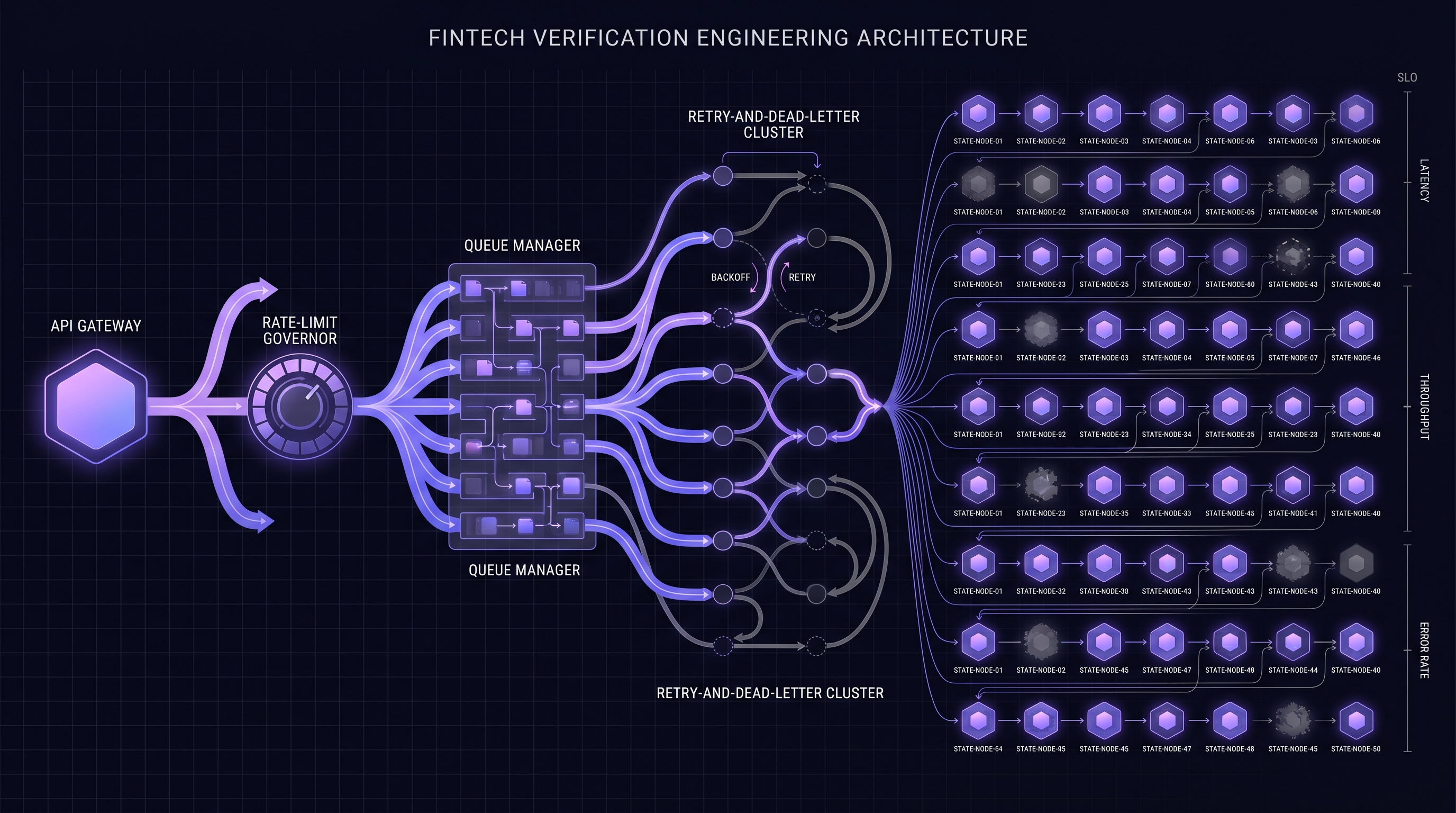
Executive Summary: Automating Secretary of State business lookups at scale is a distributed-systems problem disguised as a data-API problem. The naive build (a synchronous loop calling 50 state websites) breaks at roughly 1,000 monthly calls. The production build handles 50,000-plus calls per month by separating four concerns: rate-limit governance per state source, async-first contract design with idempotent retries, a caching strategy that does not break audit defensibility, and an SLO and observability layer that pages on state-source degradation rather than aggregate latency. This guide is the architecture-level walkthrough for the senior backend engineer or platform lead who has been told to build or buy this layer and is trying to make a defensible technical decision.
How Do You Automate Secretary of State Business Lookups at Scale in 2026?
Scale in this category means something specific: the lookup system handles unpredictable load patterns across 50 state sources with materially different latency, availability, and access policies, while producing an audit artifact for every call that survives a state examiner's review. A consumer-grade rate limiter and a retry loop will not get you there. Five engineering decisions determine whether the system survives 50,000 monthly lookups:
1. Per-source rate-limit governance. Each state has its own implicit or explicit ceiling. A global token bucket is the wrong abstraction.
2. Async-first contract design. Synchronous calls work for the fast states and break for the slow ones. The system contract should default to async with synchronous as a fast-path optimization.
3. Idempotent retries with bounded fan-out. Retry storms against state websites get your IP banned. Bounded retry with exponential backoff plus circuit-breaker isolation per source is the production pattern.[11]
4. Caching that does not break audit defensibility. Cached results need provenance metadata; otherwise a state examiner sees the cache as a compliance gap.[2]
5. SLOs that page on per-state degradation. An aggregate "p95 under 2 seconds" SLO hides a 4-minute Oregon outage. SLOs need per-source decomposition or they fail silently.
The rest of this guide walks through each of these decisions with the concrete failure modes you will hit and the architectural patterns that survive them. The audience is the senior backend engineer or platform lead with build-or-buy responsibility, not the procurement team.
Why a Naive Synchronous Loop Breaks Around 1,000 Calls Per Month
The naive build looks like a function that loops over 50 state-specific scrapers, each making an HTTP call, returning a normalized record. It works in development. It works for the first few hundred customer applications. Then three things happen at once: a slow state (Oregon, Vermont) blocks the loop for minutes, the application's request thread pool exhausts, the on-call engineer gets paged because the loan-onboarding endpoint is timing out. The loop is the wrong primitive. The right primitive is a queue plus a per-source worker pool.
Where the Build Decision Actually Lives
Most engineering leads sizing this category arrive at the same conclusion after a two-week spike: building the data plane is doable but it is a six-to-twelve-month project for two-to-four engineers, plus a permanent maintenance tail as state sites change layouts, captchas, and access policies on schedules nobody publishes. Buying the data layer (Cobalt Intelligence and a few others) shifts the maintenance burden to the vendor and collapses launch to a 3-to-5-day integration. The build decision is rarely about whether the team can do it; it is about whether the engineering hours are best spent on verification scaffolding versus the lender's actual product.
What Is the Throughput Profile of an At-Scale SoS Lookup System?
Throughput at this scale is not a single number. It is a per-source distribution with a long tail that determines almost all the engineering hard work. Honest profile across the 50 states, observed over 24 months of production traffic:
| State tier | States in tier | Median latency | 95th percentile latency | Failure mode |
|---|---|---|---|---|
| Fast | CA, TX, FL, NY, GA, IL, OH, NC, MI, AZ | 200-500ms | 1-2 seconds | Captcha changes (CA twice in 18 months) |
| Medium | ~25 states (mid-tier registries) | 500ms-2 seconds | 3-5 seconds | Rolling outages; rate-limit ambiguity |
| Paid lookup | DE primarily | 1-3 seconds | 5-8 seconds | Per-search fees that change without notice[6] |
| Slow / async-only | OR, VT, a handful of others | 30 seconds-3 minutes | 5-10 minutes | Multi-minute response under business-hour load |
| NY tier (special) | NY (volume + outages) | 800ms-2 seconds | 4-6 seconds, plus rolling outage windows | Outage windows on no published schedule |
The system contract has to handle every tier without one tier's failure mode degrading the others. A retry storm against Oregon should not deplete the worker pool serving California traffic. That isolation is what most naive builds miss.
What State Coverage Actually Looks Like Across the 50 Registries
The state landscape is not uniform; the International Association of Commercial Administrators publishes coverage standards that the better state registries align with, and the gap between aligned and non-aligned registries is where most of the engineering pain hides.[1] The implication: a 50-state lookup system has to encode per-state quirks (registry endpoint URL pattern, search field naming, response format, captcha presence) as state metadata rather than as conditional code paths.
How to Size the Worker Pool
The worker pool is per-source, not global. Concrete starting points: 8-16 concurrent workers for each fast-tier state, 4-8 for each medium-tier state, 2-4 for paid-lookup states (Delaware queues will get you charged per call), and 1-2 for slow-tier async-only states. A global pool of 100 workers shared across all states will get serialized by Oregon and starve the rest.
What to Measure During Capacity Planning
Three metrics decide whether the system can absorb the next 10x in volume: per-source 95th percentile latency, queue depth per source, and worker utilization per source. Aggregate latency is a reporting metric, not a capacity-planning metric. If 49 states are at 30 percent utilization and Oregon is at 100 percent, the right move is to add Oregon workers, not to scale globally.
How Should the API Contract Handle Sync vs. Async per State?
The cleanest contract design is async-first with synchronous as a fast-path optimization. The system always returns a workflowId at submission; for fast states, the synchronous result is included in the same response; for slow states, the result fires later via webhook callback. A consumer that always treats the response as async simplifies its code path and absorbs slow-state behavior without needing to know which states are slow.
POST /v1/business/lookup
{
  "businessName": "Acme Trucking LLC",
  "state": "OR",
  "idempotencyKey": "appl_a1b2c3_state_OR",
  "callbackUrl": "https://lender.example.com/webhooks/sos"
}

Response 202 Accepted
{
  "workflowId": "wf_8df21b4c",
  "state": "OR",
  "status": "queued",
  "expectedSeconds": 180,
  "queuedAt": "2026-05-07T14:22:08Z"
}

Webhook callback (when complete)
POST https://lender.example.com/webhooks/sos
{
  "workflowId": "wf_8df21b4c",
  "status": "complete",
  "result": { ... },
  "sourceUrl": "https://sos.oregon.gov/...",
  "fetchedAt": "2026-05-07T14:24:42Z",
  "screenshotUrl": "https://artifacts.cobalt.com/..."
}
The audit-defensibility move is the queuedAt timestamp captured at request time, not at callback time. Examiners ask why a verification took three minutes; the answer is that the request hit the queue at 14:22:08 and the state source returned at 14:24:42. The two-timestamp record is the right answer.[7]
Why Idempotency Keys Are Load-Bearing at Scale
The consumer's loan-management system will retry under network failure, application restart, queue reprocessing, and operator error. Without an idempotency key, retries against state websites count as fresh calls, exhausting rate limits, charging extra Delaware fees, and producing duplicate audit artifacts. A documented idempotency key (typically a hash of business name + state + application ID + day) collapses retries into a single source-side call and a single audit record.
Where Synchronous Wins (and Where It Loses)
Synchronous wins when the consumer is a real-time onboarding form that needs the answer to render the next page. It loses when the consumer is a batch underwriting pipeline that can absorb async webhook callbacks. Most production lender stacks should default to async and use synchronous only where UX demands it.
What Caching Strategy Survives Audit and Compliance Review?
Caching is the most-debated and most-misimplemented layer in this category. The trade-off is real: caching reduces cost and latency materially; uncached "live every time" preserves audit defensibility. The right answer is neither extreme; it is a tiered cache with provenance metadata that lets the consumer choose freshness per call.
The pattern that survives compliance review:
• Tier 1: No cache. Default for moment-of-decision verification (loan funding, account opening). Always live, always primary-source, always a fresh audit artifact. Used for regulator-facing records.
• Tier 2: Short-TTL cache (15-60 minutes). Used for in-session retries, idempotency replays, and customer-facing lookups during the same onboarding flow. Cache key includes business name, state, and a freshness signal; cached records carry both their original fetchedAt timestamp and a flag indicating cache hit.
• Tier 3: Long-TTL cache (24 hours). Used only for non-decisioning lookups (sales prospect enrichment, dashboard refreshes). Never used for audit-grade records.
The compliance-survival rule: every cached response carries a "this was a cache hit at T1, the underlying state source was last fetched at T0" header pair. Auditors do not object to caching; they object to caches that pretend to be live data.[8]
How to Invalidate the Cache When the State Says So
Some states (notably NY and CA) publish entity status changes through public feeds. A production cache subscribes to these feeds where available and force-invalidates affected records on change events. For states without public feeds, the cache TTL is the only safety net, which is why Tier 1 (no cache) is the right choice for moment-of-decision records.
The Audit-Trail Posture That Wins With Examiners
Two columns in the audit log per record: fetchedAt (when the underlying state source was queried) and servedAt (when this response was returned to the consumer). For Tier 1 records they are identical. For Tier 2 records they differ by minutes. For Tier 3 records they differ by hours. An examiner can decide which freshness window is acceptable for each use case rather than having to assume the worst.[5]
How Do You Engineer Around the Long-Tail State Failure Modes?
Each state has a failure profile, and the operations team that owns the lookup layer needs to know all 50. The cleanest pattern is to encode the failure modes as state metadata rather than handle them with conditional code paths scattered through the workers.
The Four Failure Mode Categories
• Captcha changes. California changed its public-search captcha twice in 18 months, breaking automated scrapers each time. Mitigation: independent monitoring of the public-search page DOM with alerting on structural change; vendor relationships for captcha-resolution services as fallback.
• Rolling outages. New York's SoS portal has rolling outages that affect entity lookups on no published schedule. Mitigation: circuit breaker per state with configurable open-circuit duration; queued retry with TTL; manual review hold as final fallback.
• Multi-minute response times. Oregon's response times can stretch into minutes during business-hour load. Mitigation: dedicated worker pool sized small (1-2 workers) so Oregon load does not starve other state pools; async-first contract so consumers do not block.
• Paid-lookup price drift. Delaware's per-search fees change without notice.[6] Mitigation: separate billing line item per paid jurisdiction; daily reconciliation against expected per-call cost; alerting on cost-per-call anomaly.
The Circuit Breaker Pattern That Actually Works
A naive circuit breaker opens after N consecutive failures. That breaks for state sources with intermittent slow-but-not-failed responses. A production circuit breaker opens on a sliding window of error rate plus latency degradation. Concrete configuration: open the circuit if the trailing 60-second window shows greater than 30 percent error rate OR p95 latency more than 3x the baseline; hold open for 5 minutes; probe with 1 percent of traffic before closing fully.
The Queue Topology That Survives a Bad State Day
One queue per state, sized for its expected volume plus a 3x burst margin. A dead-letter queue per state for requests that exhausted retries; the dead-letter queue is monitored by the operations team for manual review. The dead-letter pattern matters because a hard failure on a single state source should not silently drop loan applications; it should surface them to a human reviewer with the full context preserved.
What Observability and SLO Pattern Should Engineering Set?
The default observability mistake at this layer is aggregate metrics. "Average response time across all states" is operationally useless because it hides the long-tail states. The metrics that matter are per-source.
The Six Per-Source Metrics That Matter
• Per-source 95th and 99th percentile latency. Time from queue enqueue to state-source response, broken out per state.
• Per-source error rate. Percentage of requests in the trailing 5-minute window that returned an error or timeout, per state.
• Per-source queue depth. Current depth and 60-second growth rate, per state. Catches slow-state pile-ups before they cascade.
• Per-source circuit-breaker state. Open, closed, or half-open, with timestamp of last state change.
• Per-source cost-per-call. Tracks paid-jurisdiction price drift (Delaware) and surfaces billing anomalies.
• Per-source audit-artifact completeness. Percentage of completed lookups in the trailing hour with full sourceUrl, fetchedAt, and screenshotUrl present. The compliance metric that matters most. Examiner-facing teams should also track artifact completeness per OFAC and TIN sub-leg, because partial-completion lookups (entity returned, OFAC pending) need to be visible in the audit log too.[3]
The SLO Decomposition That Catches State Outages Early
Set SLOs per state tier rather than per state, otherwise the SLO config becomes unmaintainable. A reasonable starting set: fast-tier states 99.5 percent availability and p95 under 1.5 seconds; medium-tier 99 percent availability and p95 under 3 seconds; slow-tier states 98 percent availability and p95 under 5 minutes. Page the on-call rotation when any tier breaches; do not wait for an aggregate SLO to fire because by then the verification team is already escalating.[2]
Related guides on Cobalt's verification stack: How to Automate Business Verification for Lending, Best Business Data APIs for U.S. Company Verification, and How Do Lenders Verify UCC Filings and State Registrations Automatically?.
How Do You Handle Rate Limits and Retry Storms?
Rate limits at this layer come from two directions: limits the verification API vendor enforces on the consumer, and limits the underlying state source enforces on the vendor. Engineering teams that build their own data plane have to manage both; teams that buy the vendor data plane only have to manage the first. Either way, the protection patterns are the same.
The Token Bucket That Actually Survives Production
Token bucket per source, refill rate set conservatively below the source's observed limit, with a separate burst capacity to absorb application-level spikes. Concrete config for a fast-tier state with no published rate limit: refill 10 tokens per second, burst capacity 60. For a paid-lookup state: refill 2 per second, burst 5. The numbers are starting points; production tuning is informed by observed rate-limit responses (HTTP 429) from each source.
How to Prevent Retry Storms After a State Comes Back Online
The classic failure: a state source goes down for 20 minutes, the queue fills with retries, the source comes back online, every retry fires at once, the state source goes down again. Prevention: jittered exponential backoff (do not sync retries to wall-clock minute boundaries), capped retry count (3-5 retries with full jitter), and a recovery-warming window (when circuit closes, allow only 10 percent of traffic for the first 60 seconds). Together these patterns let a recovering source actually recover instead of getting hammered into another outage.[4]
The Quiet Killer: Synchronous Retries in the Consumer Application
Most retry storms originate in the consumer application's retry logic, not the data plane. A consumer that retries 5 times with no jitter on a verification timeout multiplies load fivefold against an already-degraded source. The data plane needs to assume the consumer will misbehave and absorb the storm with its own queue, rate limit, and circuit breaker. Documenting the retry contract (this API is idempotent, retries are safe, max retry budget is N per minute) reduces the blast radius.
What Should a Senior Backend Engineer Build vs. Buy?
The build-vs-buy decision at this layer is mostly about engineering hours and maintenance tail. The data is public, the protocols are HTTP, the parsing is page-specific scraping. None of that is exotic.
| Dimension | Build in-house | Buy data layer (Cobalt or similar) |
|---|---|---|
| Time to launch | 6-12 months for 2-4 engineers | 3-5 days integration |
| State coverage | Usually 5-10 states at launch, full 50 in 12-18 months | 50 states + DC from day one |
| Maintenance burden | Permanent; state sites change captchas, layouts, and policies on no schedule | Vendor's problem |
| Audit artifact | Must be built (screenshots, source URLs, retention infrastructure) | Returned by API |
| Rate limits and retries | Self-managed against unpublished state limits | Vendor manages upstream; consumer rate limits are documented |
| Pricing | Engineering payroll plus AWS infrastructure plus on-call rotation | $0.10-$0.30 per call at scale plus paid-jurisdiction passthroughs |
Cobalt's positioning: primary-source data layer that handles the 50-state coverage, rate-limit governance, audit artifact, and maintenance tail. Engineering teams plug in the API and focus their hours on the lender's actual product instead of verification scaffolding.
What Engineering Owns Even When You Buy
Buying the data layer does not eliminate engineering responsibility entirely. The consumer team still owns idempotency-key generation, async webhook handling, retry logic with jitter, audit-artifact retention in the lender's own document vault, and integration with the loan-management system's case workflow. Compliance teams will also expect engineering to maintain a beneficial-ownership data flow for entities flagged under FinCEN's BOI rule, even though BOI enforcement is operating under a voluntary-filing posture for domestic reporting companies as of early 2026.[9]
The Engineer's Honest Argument for Buying
Building the verification data plane is technically interesting and operationally thankless. The engineering team that builds it ships a side project that the product team does not see, and inherits a permanent on-call burden tied to state-government website changes. Buying the data layer reallocates those hours to product work the company actually differentiates on.
The Engineer's Honest Argument for Building
If the lender has unique data requirements (jurisdictions Cobalt does not cover, custom screenshot retention windows, in-house audit format), or if the verification stack is a strategic moat the company wants to own, building can be defensible. The decision is not technical; it is strategic. Senior engineers should bring the strategic question to the leadership team rather than answering it themselves.[10]




.jpg)


.png)