


Executive Summary: Lenders who fund without checking UCC filings are lending blind. Every merchant cash advance, equipment loan, or line of credit carries the risk that another creditor already holds a secured claim on the borrower's assets. A UCC filing API automates the lien discovery process, pulling filing data directly from state databases so underwriters can assess collateral position, detect stacking, and make credit decisions with full visibility into existing obligations. This resource covers how UCC filing APIs work, what data they return, how they compare to manual searches and enterprise platforms, and why lien discovery is a non-negotiable step in modern lending workflows.
What Is a UCC Filing and Why Does It Matter for Lending Decisions?
A Uniform Commercial Code (UCC) filing is a legal notice that a creditor has a security interest in a debtor's assets. Governed by Article 9 of the Uniform Commercial Code, these filings are recorded with state Secretary of State offices and create a public record of who has a claim on what.[1]
How Does the First-to-File Rule Affect Lender Priority?
Under UCC Section 9-322, priority among conflicting perfected security interests is determined by the time of filing or perfection. The first creditor to file a UCC-1 financing statement gets paid first if the borrower defaults or enters bankruptcy.[2] This "first-to-file-or-perfect" rule makes lien discovery essential before every funding decision. If you extend credit without checking existing filings, you may be subordinate to creditors who filed before you.
What Information Does a UCC Filing Contain?
Every UCC-1 financing statement includes the debtor's legal name and address, the secured party's name and address, and a description of the collateral. Collateral descriptions range from specific (a single piece of equipment with a serial number) to broad ("all assets, accounts receivable, inventory"). For lenders, the breadth of existing collateral claims directly impacts whether there is anything left to secure a new advance against.[3]
Why Are Manual UCC Searches a Problem for High-Volume Lenders?
Manual UCC searches require navigating individual state Secretary of State websites, each with its own interface, search logic, and response time. For lenders processing hundreds or thousands of applications per month, this approach introduces three categories of risk.
How Much Time Do Manual Lien Searches Actually Take?
Each state handles UCC searches differently. States with modern online portals return results in minutes, but others may take up to ten working days for a certified search response.[4] Search fees vary from $25 in New York to varying amounts across other jurisdictions, and expedited processing adds additional costs (New York charges $75 for same-day processing).[4] Multiply this across multiple states per applicant, and the time and cost burden becomes significant for any lender processing volume.
What Filing Errors Make Manual Searches Unreliable?
Approximately 20% of all UCC filings contain an error that can impact a lender's lien position in the borrower's collateral.[5] Research on Florida's filing system found that 32% of filings against registered organizations were ineffective due to debtor name errors alone.[6] Common errors include:
• Debtor name mismatches. Courts consistently hold that even minor errors in a debtor's name, such as a missing comma, extra letter, or incorrect suffix, can be fatal to perfection.[7]
• Wrong jurisdiction filings. Filing in the wrong state invalidates the lien entirely, creating an unperfected security interest.[7]
• Insufficient collateral descriptions. Vague or inconsistent descriptions can cause courts to find the security interest unperfected or inferior to competing claims.[7]
• Continuation statement lapses. Failing to file a UCC-3 continuation within the six-month window before expiration causes the perfection to lapse, making the security interest unperfected against third parties.[8]
• Rekeying errors during manual data entry. Mid-size and large lenders have identified rekeying as a primary source of errors, which is why technology solutions are increasingly adopted to eliminate this step.[5]
How Does Incomplete Lien Data Increase Default Exposure?
When a lender misses an existing UCC filing, they may fund a deal without realizing they hold a subordinate position on the collateral. In the MCA industry, where default rates range from 7% to 21% depending on the study and time period, this gap in lien visibility directly translates to recovery risk.[9] A lender who discovers post-funding that three other creditors already hold "all assets" liens has limited recourse.
How Does a UCC Filing API Work?
A UCC filing API connects your loan origination system or underwriting platform directly to state UCC filing databases, returning structured lien data in a format your systems can process automatically.
What Does a Typical API Request Look Like?
With Cobalt Intelligence's UCC Filing Data API, lien discovery is a single parameter added to a standard Secretary of State search. There is no separate endpoint or additional integration required:
curl --location 'https://apigateway.cobaltintelligence.com/v1/search?searchQuery=Acme%20Corp&state=delaware&uccData=true&liveData=true' \
--header 'x-api-key: Your_API_Key' \
--header 'Accept: application/json'
Setting `uccData=true` returns UCC filing data alongside the standard entity verification response: business status, filing date, officers, and registered agent. One call, two layers of due diligence.
What Data Fields Does the API Return?
The response includes structured fields for each UCC filing found against the business:
{
  "status": "complete",
  "statusCode": 200,
  "results": [
    {
      "title": "ACME CORPORATION",
      "status": "Active",
      "filingDate": "2015-03-15",
      "uccFilings": [
        {
          "fileNumber": "2024-1234567",
          "filingDate": "2024-06-15",
          "securedParty": {
            "name": "First National Bank",
            "address": "123 Bank St, Wilmington, DE 19801"
          },
          "debtor": {
            "name": "ACME CORPORATION",
            "address": "456 Corporate Blvd, New York, NY 10001"
          },
          "collateralDescription": "All assets, accounts receivable, inventory"
        }
      ]
    }
  ]
}
Key data points returned per filing include:
• Filing number and dates. The state-assigned UCC filing reference number, original filing date, and any amendment dates.
• Secured party information. The name and address of the creditor holding the lien.
• Debtor information. The legal name and address of the business with the filing against it.
• Collateral descriptions. The specific assets pledged as collateral, from "all assets" to narrowly defined equipment or receivables.
• Filing status. Whether the filing is active, lapsed, or amended.
This structured data feeds directly into automated underwriting rules. No manual interpretation, no rekeying, no navigating state websites.
How Do Lenders Use UCC Filing Data to Detect Stacking?
Stacking, the practice of taking multiple merchant cash advances simultaneously from different funders, is one of the highest-risk scenarios in alternative lending. Each advance carries its own daily withdrawal, factor rate, UCC lien, and personal guarantee. The combined daily drain from stacked MCAs can consume 15% to 30% or more of a business's daily revenue.[10]
What Does a Stacking Pattern Look Like in UCC Data?
When an API returns multiple UCC filings against the same debtor, each with a different secured party, underwriters can assess:
• Number of existing positions. Three or more active UCC filings from different MCA providers is a strong stacking signal.
• Filing dates and frequency. Multiple filings within a 90-day window suggest a borrower is cycling through funders.
• Collateral overlap. Multiple "all assets" liens from different creditors means each position is diluted. The first-to-file creditor has priority; later filers may recover little or nothing.
• Secured party identification. Recognizing known MCA funder names in the secured party field helps distinguish between traditional bank liens and alternative lending positions.
Without automated UCC data, underwriters rely on self-reported debt schedules from applicants, which are often incomplete. UCC reports provide full transparency into outstanding liens, helping lenders determine whether a borrower is already over-leveraged.[11]
How Can Lenders Build Stacking Rules Using API Data?
Because the API returns structured JSON, lenders can build automated rules:
• Hard decline. If UCC filing count exceeds a threshold (e.g., 4+ active filings from different secured parties).
• Manual review. If 2-3 filings exist, route to an underwriter for assessment of filing dates and collateral descriptions.
• Auto-approve. If zero or one filing exists with specific collateral (not "all assets"), proceed with standard underwriting.
These rules replace the judgment calls that manual lien searches force onto operations teams. The data is the same; the speed and consistency are not.
For a deeper analysis of how UCC filing data fits into the collateral verification workflow, see UCC Filing Data for Alternative Lenders: The Collateral Blind Spot.
How Does a UCC Filing API Compare to Manual Search and Enterprise Platforms?
Lenders evaluating UCC lien search solutions typically consider three options: manual searches through state websites, enterprise platforms from providers like CT Corporation (Wolters Kluwer) and CSC Global, or API-first data providers. Each serves a different use case.
What Do Enterprise UCC Platforms Offer?
CT Corporation's iLien platform and CSC Global's Lien Perfect are full-service UCC management solutions built for large financial institutions and law firms.
• CT Corporation / Wolters Kluwer. iLien covers 4,300+ filing office jurisdictions, offers end-to-end UCC lifecycle management (search, file, monitor, continue), and provides API integration into loan origination systems. Their platform includes jurisdiction-specific templates to minimize filing rejections and automated continuation tracking.[12][13]
• CSC Global. CSC maintains what they describe as the industry's largest online UCC database, with keyword search logic designed to find records with name variations, misspellings, and incorrectly indexed names. Their Lien Perfect for Lenders platform offers CRM and loan system integration.[14]
These platforms excel at UCC lifecycle management: filing, monitoring, continuation, and amendment. They are designed for lending operations that need to manage their own UCC filings in addition to searching existing ones.
Where Does an API-First Approach Fit?
For lenders whose primary need is pre-funding lien discovery rather than full UCC lifecycle management, an API-first approach offers a different value proposition:
• Integration simplicity. A single API parameter (`uccData=true`) added to an existing entity verification call returns lien data alongside business status, officers, and filing dates. No separate platform, login, or workflow.
• Combined data delivery. Entity verification and lien discovery in one response reduces both integration complexity and per-lookup workflow steps.
• Credit-based pricing. UCC data is included in the standard SOS Search credit (1 credit per lookup) rather than priced as a separate service.
• Pre-screening focus. The API is optimized for the "should we fund this deal?" question, not for filing or managing your own UCCs post-funding.
The difference comes down to workflow fit. If you need to file, monitor, and manage UCC liens across their lifecycle, enterprise platforms like iLien or Lien Perfect are purpose-built for that. If you need fast, structured lien data as part of your underwriting decision, an API call that returns UCC filings alongside entity verification data is the more direct path.
For a comparison of real-time UCC data platforms across multiple states, see What Platforms Offer Real-Time UCC Updates Across Multiple States?.
What Does a Collateral Verification Workflow Look Like with API Data?
Collateral verification is the process of confirming what assets a borrower can pledge and whether those assets are already encumbered. For alternative lenders, this workflow determines whether a deal is worth funding.
How Should Lenders Structure the Pre-Funding Check?
A standard collateral verification workflow using UCC filing API data follows this sequence:
• Step 1: Entity verification. Confirm the business exists, is in good standing, and matches the applicant's representations. The API returns `normalizedStatus` (active, inactive, pending, unknown) along with filing date, officers, and registered agent.
• Step 2: Lien discovery. With `uccData=true`, the same API call returns all UCC filings against the business. Review filing count, secured party names, and collateral descriptions.
• Step 3: Position assessment. Determine where your potential filing would rank in the priority stack. Under the first-to-file rule (UCC 9-322), earlier filings take priority.[2] If multiple "all assets" liens exist, your position may offer limited recovery value.
• Step 4: Stacking analysis. Count the number of unique secured parties. Cross-reference against known MCA funder names. Flag patterns that suggest the borrower is cycling through funders.
• Step 5: Decision routing. Based on the data, route to auto-approve, manual review, or decline. Structured API data enables rules-based routing rather than case-by-case judgment.
What Complementary Data Should Lenders Pair with UCC Searches?
UCC filings show secured credit claims, but they do not capture the full risk picture. A thorough pre-funding check combines lien discovery with:
• TIN/EIN verification. Confirm the business's tax identification number matches IRS records. This catches identity discrepancies before you file your own UCC-1.
• Court records search. Check for judgments, lawsuits, and litigation that may indicate financial distress beyond what UCC filings reveal.
• OFAC sanctions screening. Verify the business and its principals are not on the Specially Designated Nationals (SDN) list.
This layered approach gives underwriters a complete view: Is the business real? Is the identity confirmed? Are there existing liens? Are there legal actions? Each data point adds to the decision, and each can be retrieved through a single API provider.
Get API access to run your first UCC filing search.
What Are the Current Coverage Limitations of UCC Filing APIs?
No UCC filing API covers every state and every filing office. Understanding coverage gaps is critical for lenders operating across multiple jurisdictions.
How Many States Does Cobalt's UCC Data Currently Cover?
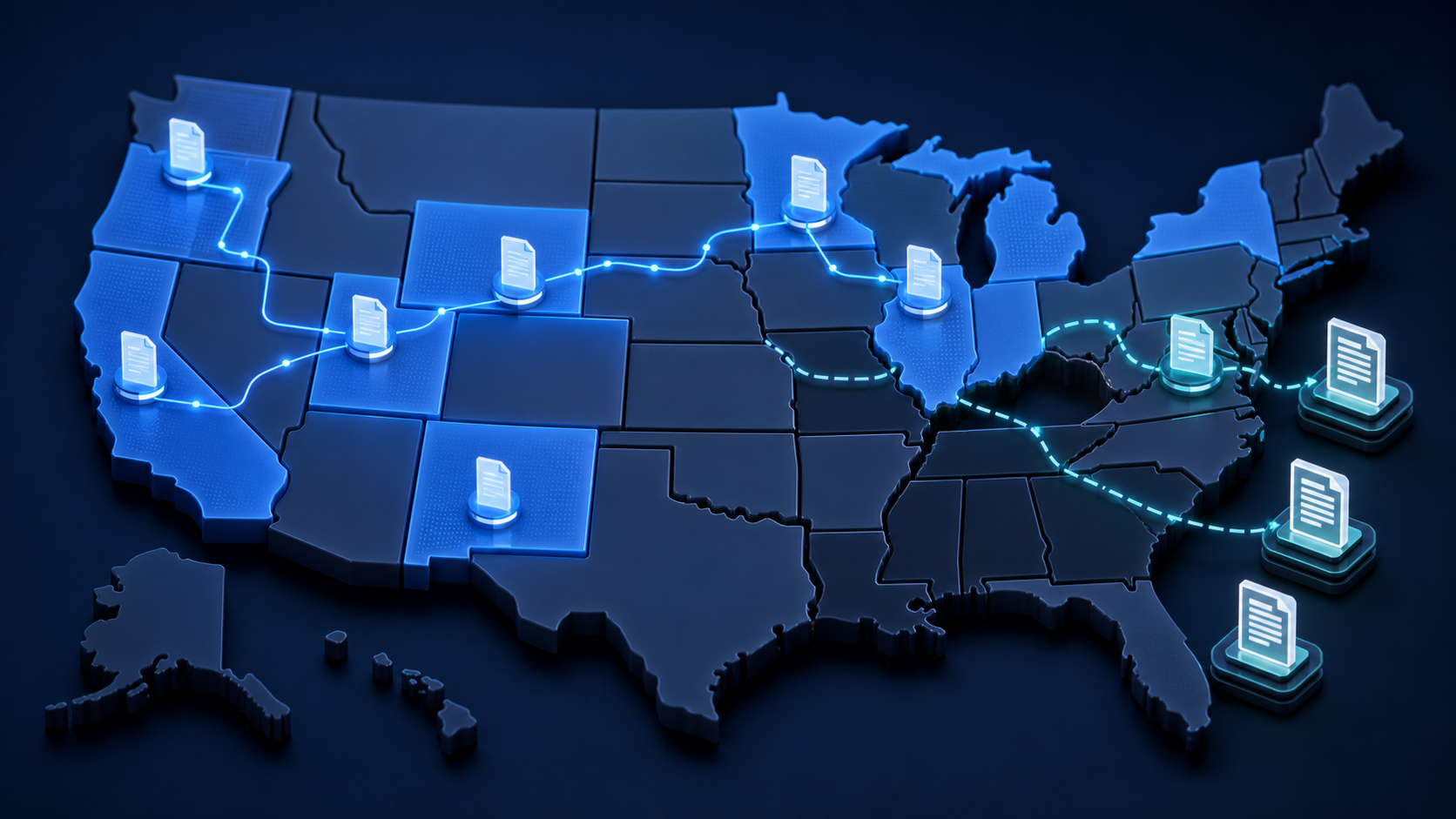
Cobalt Intelligence's UCC Filing Data API currently covers 11 states. These states represent a significant share of business filings, but gaps exist. For states outside the current coverage, lenders will need to supplement with manual searches or an enterprise platform.
What Other Limitations Should Lenders Know About?
Beyond state coverage, there are inherent limitations in UCC filing data that apply to any provider:
• Tax liens are not included. Federal and state tax liens are filed through separate systems (IRS for federal, state tax agencies for state) and are not captured in UCC databases.[15]
• Filing lag exists. There is an inherent delay between when a UCC-1 is submitted to a state filing office and when it appears in the searchable database. This lag varies by state and can range from same-day to several business days.
• Collateral description quality varies. Some filings use detailed descriptions; others use broad language like "all assets." The quality of this field depends entirely on what the filing party submitted, not on the data source.
• Federal filings may require separate sources. Certain federal UCC filings are not captured in state-level databases.
Honest assessment: if your lending operation requires nationwide UCC coverage with filing and monitoring capabilities, you need an enterprise platform. If your primary need is fast lien discovery in supported states as part of a broader verification workflow, the API approach covers that with less integration overhead. Many lenders use both: an API for pre-screening speed and an enterprise platform for post-funding UCC management.
What Recent Legal Changes Affect UCC Filing Data for Lenders?
The UCC is not static. Recent amendments and new articles have expanded the framework in ways that directly impact how lenders use filing data.
How Do the 2022 UCC Amendments Change the Landscape?
As of mid-2025, more than half of U.S. states have adopted the 2022 amendments to the Uniform Commercial Code, which include revisions to Article 9 and the addition of Article 12.[16] Key changes for lenders:
• Digital asset collateral. Article 12 creates a new asset category called "controllable electronic records" (CERs), expanding the range of assets that can serve as collateral in secured transactions.[16]
• Updated perfection rules. The revised Article 9 includes updated rules for perfecting security interests in digital assets, which will generate new filing types that lenders need to account for in their search processes.
• State-by-state adoption timeline. Because UCC adoption is state-level, lenders operating across jurisdictions need to track which states have adopted the 2022 amendments and which still operate under the prior version.
For lenders using UCC filing APIs, these changes mean the data returned by searches will evolve. New collateral types, new filing categories, and new perfection rules will appear in state databases as adoption spreads. API providers that update their data parsing to accommodate these new filing types will deliver more complete results than providers that do not.
Schedule a demo to see UCC filing data in action.
How Should Lenders Evaluate UCC Filing API Providers?
Not all UCC data sources are equivalent. When evaluating providers, lenders should assess five factors.
What Questions Should You Ask Before Choosing a Provider?
• State coverage. How many states are supported? Does the provider publish a specific list? Are new states being added on a roadmap?
• Data freshness. Is the data pulled live from state databases, or is it cached from periodic batch updates? Cached data may be weeks old, which matters for detecting recent filings.
• Response structure. Does the API return structured JSON with parsed fields (secured party, debtor, collateral description), or does it return unstructured text that requires your team to parse?
• Integration model. Is UCC data available as a parameter on an existing API call, or does it require a separate integration? Fewer integrations mean faster deployment and lower maintenance.
• Pricing model. Is UCC data priced per search, per filing returned, as a monthly subscription, or included in an existing credit system? Volume pricing matters for high-throughput lenders.
What Makes a Provider Trustworthy for Lending Decisions?
Beyond technical specifications, lenders should verify:
• Source transparency. Does the provider disclose where the data comes from? Primary-source data pulled directly from state databases is more reliable than aggregated data from third-party intermediaries.
• Known limitations documented. Providers who publish their coverage gaps, filing lag disclaimers, and data quality caveats are more trustworthy than those who claim universal coverage without qualification.
• Audit trail capability. For compliance purposes, can you retrieve a record of what was searched, when, and what was returned? Timestamped responses and screenshots provide defensible documentation for examiners.
Talk to the Cobalt team about UCC filing data for your underwriting workflow.




.jpg)


.png)