


The Recently-Formed Segment: Why It Is the Hardest to Verify
Wolters Kluwer counted nearly 5.5 million new business formations across 47 states in 2025, with LLCs representing roughly 85 percent of those formations.[1] Delaware added 329,796 formations (up 13.1 percent year over year), Texas added 449,838 (up 8.4 percent), and Florida led absolute volume at 665,668. That is the volume of businesses that, on any given day, sit inside a propagation window between the state registry and your vendor's cache.
For alternative lenders underwriting small-ticket deals, that same pool is a material share of the inbound application flow. Merchant cash advance providers, invoice factoring shops, equipment financing lenders, and working-capital originators are all exposed disproportionately because their product-market fit is weighted toward newer and smaller operators.
Why the segment concentrates false no-matches
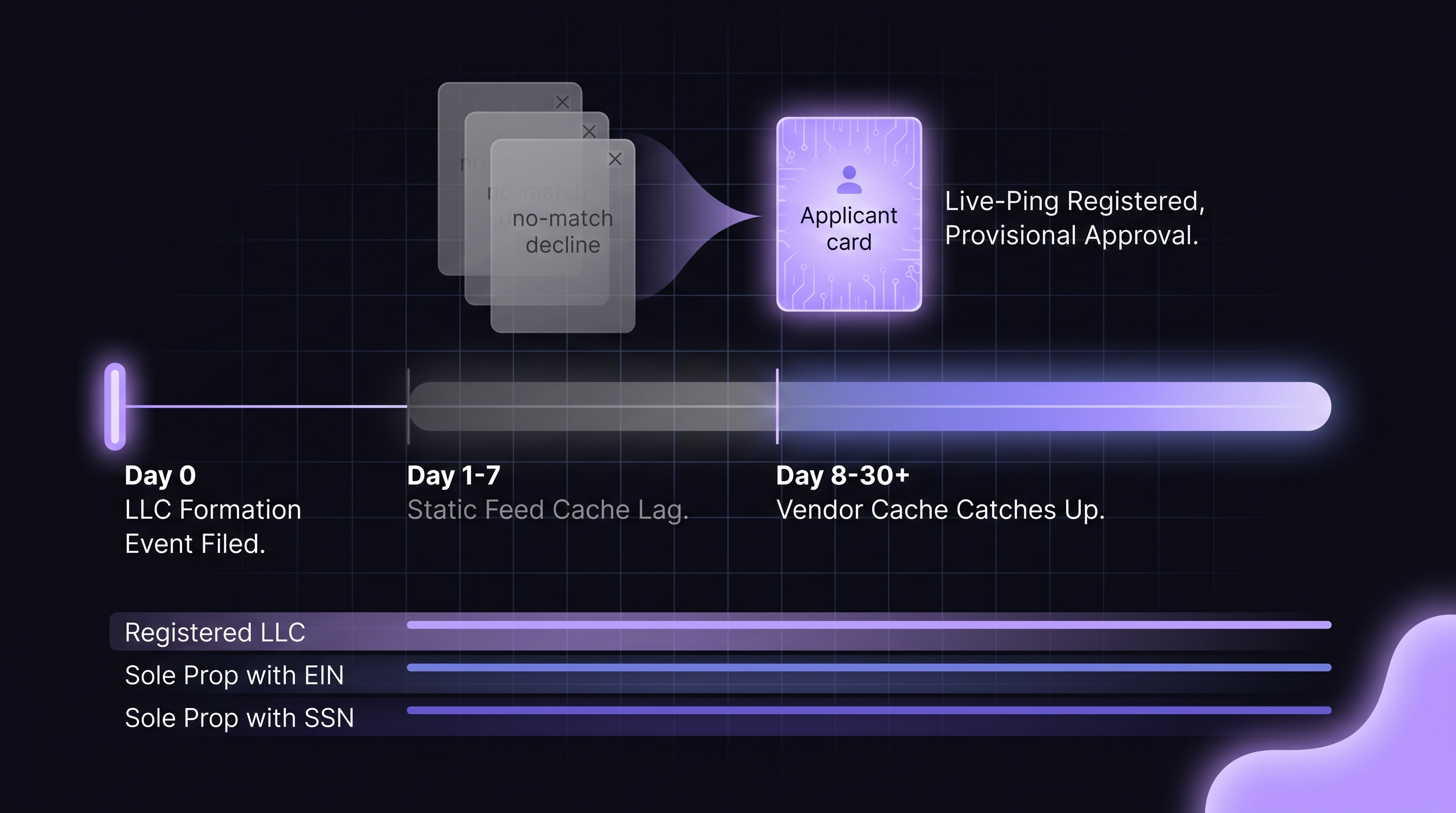
A newly-formed LLC fails verification from a static-feed vendor not because the business is fraudulent, but because the vendor's cache has not yet ingested the state's record. The operator sees a "no match" response and has two ambiguous interpretations: the business was not registered (decline signal) or the business was registered but is invisible to the feed (data-lag signal). Static-feed architecture cannot distinguish the two. Live-ping architecture queries the state registry directly and can.
The false-negative band on newly-formed entities is directionally higher than on established ones. Published vendor survey data from 2025 shows false positives and false negatives as a top-three challenge for roughly 60 percent of verification providers overall,[2] and the segment-specific rate on sub-12-month entities is meaningfully worse than the cross-segment average. Your own shop's rate depends on your state mix and vendor cadence; run the sampling yourself.
What "Newly Formed" Actually Means in Verification Terms
The definition matters because the verification policy hinges on it.
The 12-month window and why it is conventional
"Newly formed" in risk-policy documents usually means formation date within the last 12 months. The 12-month threshold is conventional rather than regulatory: it reflects the typical aggregator propagation tail plus a buffer for state-specific slow states (Oregon, New Jersey). Some shops use 24 months; a few use 6. The right threshold for your shop is the one where your vendor's observed false-negative rate drops to acceptable levels, which you measure through sampling.
Sole proprietors: registered and unregistered
A sole proprietorship is legally a business entity from day one, but the verification implications split based on whether the owner elected to register. An operator doing business under their personal name is typically not in a state registry at all. An operator doing business under a DBA ("doing business as") may or may not be, depending on state. A sole proprietor who formed an LLC to hold the business is in the registry under the LLC entity. The CFPB's small-business lending rule treats all three categories as "small business" regardless of entity form.[3] Your verification policy needs to handle all three separately.
The entity-lifecycle perspective
Newly-formed is not a binary. A business formed 3 months ago has different verification risk than one formed 11 months ago, even though both fall inside a 12-month window. Cache freshness improves over time; fraud signals concentrate in the first 90 days. Treat the window as graded, not flat.
Where Static Feeds Fail on Day-Old LLCs
The architectural failure modes track with the broader cache-vs-live-ping analysis, with a few that hit the newly-formed segment especially hard.
Propagation lag inside the vendor pipeline
State registries push updates on their own cadence. Aggregators ingest on their own cadence. The cumulative window between a formation filing and an aggregator's fresh record routinely exceeds a week. On any given day, the previous week of formations is either absent from the cache or present but with partial data. Your vendor's "fresh" label on such records is often misleading because the record is there but incomplete (missing officers, missing address, missing status).
Name normalization on brand-new filings
Newly-formed businesses have less cross-referenced data in aggregator pipelines, which means that normalization heuristics (trade-name variants, trailing-punctuation matching, officer-name matching) have less to work with. A cached match that would resolve cleanly on an established entity can return low confidence or no match on a newly-formed one, not because the business does not exist, but because the aggregator has not built up enough signal to normalize against.
Sole proprietor and DBA data is frequently absent from feeds
DBAs registered at the county level (common in Texas, California, New York) typically do not flow into state-level aggregator feeds at all. Sole proprietorships operating without DBA registration do not exist in any business registry. Verification for these businesses has to combine IRS TIN/EIN verification, bank account verification, and personal identity verification rather than relying on entity-registry lookup.
Sole Proprietors and DBAs: The Entity-Formation Gap
This is the segment where most KYB verification architectures are weakest, because the mental model assumes an LLC or corporation on the other side.
The TIN/EIN path for sole proprietors
An operating sole proprietorship with an EIN can be verified against IRS records by EIN-to-legal-name match, regardless of whether the business appears in any state registry.[4] For operators using their SSN rather than an EIN, the verification shifts to personal identity and bank-account validation; there is no business-entity verification surface.
DBA verification at county level
County-level DBA filings require manual verification against the specific county's clerk records, which typically do not have API access. Some vendors cover the larger counties; most do not. For shops with applicant flow concentrated in a few states, it may be worth sourcing county DBA data directly or accepting document-upload verification in place of API-based lookup.
Cross-signal combinations
For sole proprietors, the verification stack works best as a combination of signals rather than a single entity check: EIN-to-legal-name from the IRS, bank statements validating the operating flow, address match across sources, and personal identity verification on the owner. No single signal is load-bearing; the combined confidence supports the decision.
A Verification Playbook for Sub-12-Month Businesses
A policy that handles the newly-formed segment cleanly looks different from one that handles established businesses.
Route recently-formed entities to live-ping by default
Any entity with a reported or detected formation date within the last 12 months should trigger live-ping against the state registry as the primary verification path, not a fallback. The cache layer is still useful for the subset where the entity has already propagated and has enough confidence to auto-accept, but the default routing should assume live-ping.
Expect async delivery and design UX around it
Live-ping latency is 10 to 300 seconds. The onboarding UX should accommodate this with a "verification in progress" state and async result delivery. The synchronous path captures what can be captured immediately (application data, personal identity, preliminary credit check); the async path completes the business-entity verification when the state returns. Onboarding is not gated on the slow-state tail.
Require timestamped state-registry evidence for high-value decisions
For deal values above your threshold, require a timestamped screenshot or equivalent artifact of the state registry at the moment of verification. This becomes the audit-defense record for the decision and the primary evidence if the applicant later disputes the entity status.
Tier the verification layers by applicant type
| Applicant Type | Primary Verification | Secondary Signals | Audit Artifact |
|---|---|---|---|
| LLC or Corp, formed within 12 months | Live-ping to state registry | EIN match, officer verification | Timestamped registry screenshot |
| LLC or Corp, formed more than 12 months ago | Cache lookup with live-ping fallback | EIN match, UCC check | Cached record plus fallback log |
| Sole proprietor with EIN | IRS TIN/EIN legal-name match | Bank account verification, personal identity | IRS response + bank account proof |
| Sole proprietor without EIN (SSN) | Personal identity verification | Bank account, address match | Identity verification record |
| DBA at county level | Document upload (scanned DBA filing) | EIN match if applicable | Filed document + cross-reference |
Combine with UCC and court records for high-confidence signal
For the newly-formed segment specifically, absence of UCC filings and court records is a confirming signal (not a decline signal on its own, but consistent with a legitimate new business). A newly-formed LLC with zero UCC filings, no court records, and a fresh state-registry match is the expected profile. Anomalies (multiple UCC filings on a 30-day-old LLC, court records predating the formation date) are the flag.
Fraud Signals Specific to the Newly-Formed Segment
First-party fraud is the dominant pattern in small-business lending fraud. LexisNexis Risk Solutions reported in its 2024 SMB Lending Fraud Study that first-party individuals account for roughly 75 percent of fraud cases at online lenders and pure-play lending groups.[5] The newly-formed segment is where first-party fraud concentrates because the fraudster has less verification surface to evade.
Recently-formed entities with no operational history
A business formed 30 days ago with a clean registry match, a valid EIN, a functional business bank account, and a funded application is not automatically fraud, but the combination warrants enhanced review. Legitimate newly-formed businesses usually have a visible operational footprint (website, social presence, public address, industry-consistent bank flow). Shell operations formed to run a financing application do not.
Officer overlap across recently-formed entities
A person listed as officer or registered agent on multiple recently-formed entities is a classic stacking or synthetic-identity signal. Find Related Businesses type features surface this pattern: one person associated with five LLCs formed in the last six months, each applying for financing, is a coordinated fraud pattern rather than five independent customers.
Address collisions on registered-agent services
Registered-agent services are legitimate and common, but an address that appears as registered agent on a high volume of recently-formed entities from the same applicant pool is a signal for enhanced review. This does not decline on its own; the agent service is legitimate. It does warrant additional verification of the underlying operational address.
Applicant-reported formation date inconsistencies
When the applicant-provided formation date does not match the state registry, investigate. Legitimate discrepancies exist (confusion between formation and DBA-registration dates, multi-entity structures where the applicant is unsure which entity is the contracting party), but the pattern is also a synthetic-identity signal worth screening.
Balancing Onboarding Speed Against Freshness Guarantees
The operational tension in the newly-formed segment is that fast deal competition favors sub-24-hour approvals, while the verification architecture for this segment favors async live-ping with latency measured in minutes for slow states.
Partial approval as a UX pattern
Many shops handle this by running a staged approval: provisional decision based on fast signals (identity, credit, bank flow), final approval gated on the async verification completing. The applicant sees a "conditionally approved, verification pending" state that typically resolves within an hour for most states. Deal competition is on the provisional decision; funding waits on the final.
Async risk controls for in-flight verifications
If the business operates correctly in provisional state (funded bank account verified, pull-back available on adverse verification result), the conversion benefit of fast provisional approval outweighs the risk of late-stage verification rejection. The risk control is the ability to claw back the decision if the async verification returns a flag.
State-mix weighting
A shop with heavy Oregon or New Jersey exposure will see longer async tails than one weighted toward Texas or Delaware. The UX pattern should adjust: faster provisional-approval thresholds for fast-state applicants, more conservative provisional-approval thresholds for slow-state applicants.
The Newly-Formed Verification Checklist
Before the next policy review, run your newly-formed onboarding flow against this checklist.
• Formation-date detection on the applicant record, with live-ping trigger for anything inside the 12-month window.
• EIN-to-legal-name match via IRS TIN verification for every applicant with an EIN.
• Sole proprietor path with identity and bank-account verification for applicants without an EIN.
• DBA coverage policy (API where available, document upload where not).
• Officer overlap detection across recently-formed entities in your applicant flow.
• Registered-agent concentration monitoring for address clusters.
• Timestamped state-registry evidence for deal values above threshold.
• Async verification UX that does not block synchronous onboarding.
• Claw-back policy for provisional approvals where async verification returns adverse.
• State-mix latency awareness in the UX timing expectations.
The shops that process the newly-formed segment cleanly have all of these in place. The shops that struggle have two or three and call it KYB.
Related entity-resolution reading
When this workflow begins with an unconfirmed business name, select a likely entity before requesting the full Secretary of State record. Candidate selection is a distinct step, not a verification finding or lender decision.
In this series: Consumer vs. Business Entity Intake for Lending Workflows and The Delaware Name-Change Gap and Other State-Level Feed Failures in Business Verification (2026).





.jpg)


.png)