


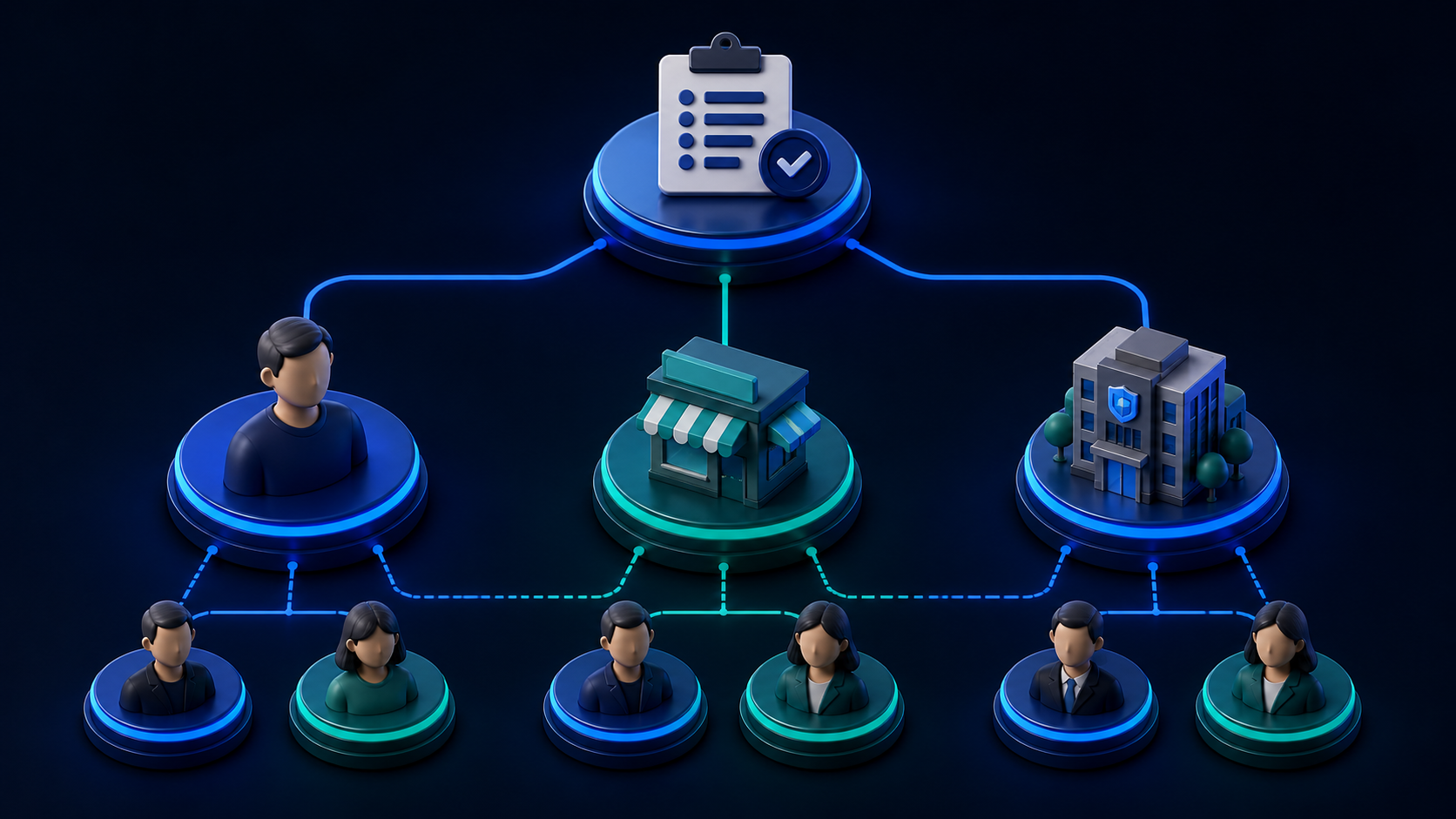
Executive Summary: The first verification decision is not whether the applicant matches a database. It is whether the customer is a natural person, a legal business entity, or a relationship between both. If intake sends a sole proprietor, LLC, DBA, owner, and guarantor through one generic business flow, later checks may be accurate for the wrong subject. A safe design classifies the legal customer first, maps every human and business role, then collects the identifier and evidence appropriate to each one.
Which Subjects Can Appear in One Application?
• Natural-person applicant.
• Sole proprietor.
• DBA or trade name.
• Corporation or LLC.
• Partnership.
• Business borrower.
• Beneficial owner or control person.
• Individual or entity guarantor.
• Authorized user.
Those labels are roles and legal forms, not interchangeable synonyms.
Classify the subject before selecting the verification source.
Why Is a Sole Proprietor Different From an LLC?
SBA guidance describes common business structures and their different legal characteristics.[1] A corporation or LLC is created through a state legal process. A sole proprietorship generally is not a separate legal entity from its owner, even if it uses a trade name or business tax account.
FinCEN's consolidated CDD FAQs discuss sole proprietorships in the context of covered financial institutions and distinguish them from legal-entity customers.[2] That regulatory scope should not be generalized to every lender, but the identity distinction is operationally useful.
What Is a DBA?
A DBA is a trade name. It does not by itself prove a separate legal entity, owner, tax identity, or contracting party. Preserve it as an alias connected to the correct person or entity.
IRS guidance explains that corporate name control is based on the legal name associated with the EIN and generally excludes DBA text.[3]
Which Identifiers Belong to Which Subject?
Do not treat EIN, SSN, ITIN, state entity ID, license number, and account number as substitutes.
Business entity
• Legal name.
• State and entity ID.
• EIN where applicable.
• Formation and foreign-registration records.
• Licenses tied to the entity.
Natural person
• Legal personal name.
• Identity evidence under the applicable KYC process.
• SSN or ITIN only under authorized controls and purpose.
• Owner, control, guarantor, or user role.
Cobalt's TIN/EIN product validates a supplied business-name and tax-ID pair. It does not classify the applicant, discover an EIN, or verify a natural person's identity.[4]
How Should the Intake Decision Tree Work?
who is legally receiving the credit?
  -> natural person
  -> sole proprietor using a trade name
  -> state-created legal entity
  -> multiple related parties
Then ask which humans own, control, guarantee, or act for the business. Store each subject separately and link the roles.
Minimum fields
1. Customer type selected and evidence.
2. Legal customer name.
3. Trade names.
4. State formation information.
5. Tax-identifier type.
6. Owners and control persons.
7. Guarantors.
8. Authorized users.
9. Account and payment relationships.
What Should Happen When Intake Is Ambiguous?
• Trade name only. Ask who legally owns and operates it.
• Individual and LLC both listed. Identify the borrower, guarantor, and account holder separately.
• No state record. Determine whether the subject is a sole proprietor, wrong jurisdiction, recent filing, or unresolved entity.
• EIN with personal name. Verify the legal structure and correct name before running a business pair check.
• Several related companies. Map each role rather than merging names.
SBA registration guidance distinguishes formation from foreign qualification and trade-name registration.[5]
How Should Verification Route by Subject?
State-created entities can route to SOS search and, when collected, business name and EIN validation. Natural persons route to the lender's authorized KYC and credit controls. Owners and guarantors remain linked to, but distinct from, the business borrower.
An entity type should not be treated as a proxy for creditworthiness. Classification determines which evidence is relevant, not whether the subject is safe.
What Should the Audit Record Preserve?
• Original applicant selection.
• Evidence supporting customer type.
• Every person and entity subject ID.
• Role relationships.
• Identifiers collected and purpose.
• Verification events and source coverage.
• Corrections and reviewer disposition.
• Policy version and decision.
What Should Teams Monitor?
• Intake records reclassified after review.
• DBA-only applications.
• Sole proprietors sent incorrectly to entity search.
• Multiple-party applications missing roles.
• EIN checks run before legal-name resolution.
• Guarantors merged into owner records.
• Decisions made while customer type was unresolved.
What Is the Practical Intake Sequence?
Identify the legal credit customer, classify person versus entity, preserve DBAs as aliases, map owners and guarantors as separate roles, collect the correct identifiers, then run the appropriate business and consumer controls.
Cobalt can supply state business records and business name and EIN validation. The lender owns consumer identity, KYC, role mapping, credit policy, and decisions.
Ready to test the decision tree on a sole proprietor, single-member LLC, and multi-entity borrower? Schedule a Cobalt Intelligence demo and bring the intake fields that currently cause rework.
Related entity-resolution reading
When this workflow begins with an unconfirmed business name, select a likely entity before requesting the full Secretary of State record. Candidate selection is a distinct step, not a verification finding or lender decision.
In this series: How to Turn No-Match Results Into Finite-State Workflows and How to Verify Newly-Formed LLCs and Sole Proprietors at Onboarding in 2026.





.jpg)


.png)