



Executive Summary: Lenders who deliberately fund distressed borrowers do not use court records the way a conventional underwriter does. Litigation is not a disqualifier in this lane; it is the expected condition of the asset, and the only question that matters is whether a given case changes your recovery position relative to the security you intend to take. This post covers how to read judgment lien priority against your intended position, how pending and final judgments should price differently, when a judgment is a buying signal rather than a warning, and where the available data stops.
What Does Distressed Lending Actually Require From Court Data?
Business bankruptcy filings increased 11.4 percent over the twelve months ending March 31, 2026, rising from 23,309 to 25,960 cases, and total filings climbed to 591,850 from 529,080 a year earlier.[1] Most of that volume is not reorganization: Chapter 11 petitions accounted for 8,405 filings in the year ending December 2025, roughly 35 percent of all business cases.[15] Bank credit has not moved to absorb that stress. In the April 2026 Senior Loan Officer Opinion Survey, modest net shares of domestic banks reported tightening standards on commercial and industrial loans to firms of every size while demand stayed roughly flat.[2] The gap between borrowers in trouble and banks willing to fund them is the market special situations lenders serve.
Why Is "Is There Litigation" the Wrong Screening Question?
A binary litigation flag is a screening tool built for a lender whose thesis is that the borrower is healthy. If your thesis is that the borrower is impaired and you are pricing for it, a yes/no answer carries almost no information. Every file in your pipeline will return yes. The flag tells you nothing about whether the plaintiff already holds a docketed judgment, whether the case is a collection action or a commercial dispute, whether the amount is material against enterprise value, or whether the judgment attaches to the same collateral you plan to take.
Conventional underwriting treats a court hit as a stop. Distressed underwriting treats it as an input to a waterfall. That changes what you need out of a search: not a count of cases, but the creditor identity, the amount, the filing date, the case status, and the jurisdiction. Those five fields determine where you land in line.
What Does Litigation Tell You About Recovery Position?
Recovery assumptions in leveraged credit have been drifting down for reasons that have nothing to do with individual borrower quality. Moody's found that lenders recovered an average of 57 percent on first-lien covenant-lite loans between 2023 and mid-2025, against 66 percent on loans carrying financial maintenance covenants.[3] The mechanism behind that spread is position rather than borrower quality: under Article 9, priority among competing claims to the same collateral generally runs to whoever filed or perfected first, so a junior position absorbs losses before a senior one does.[4]
Those figures describe syndicated credit, not small-balance commercial lending, but the lesson transfers. The gap between the covenant-lite and maintenance-covenant outcomes is a function of structure and position, not of borrower intent. Court records are one of the few pre-close sources that tell you who has already claimed a position ahead of yours.
How Does Judgment Lien Priority Affect Your Intended Security Position?
Priority is a timing question answered by statute, and the statute differs by state and by asset class. Reading a judgment without reading the perfection rule that governs it produces a confident wrong answer.
When Does a Docketed Judgment Outrank a Later Secured Lender?
In New York, a money judgment becomes a lien on the debtor's real property when it is docketed with the clerk of the county where that property sits, and it holds for ten years from the filing of the judgment-roll. No transfer of the debtor's interest in that real property is effective against the judgment creditor during that window.[5] If a plaintiff docketed a judgment in Kings County in 2024 and you record a mortgage against the same property in 2026, you sit behind that judgment on the property, regardless of how the deal was papered.
Florida runs a different mechanism for personal property. A judgment creditor acquires a lien on the debtor's personal property, including payment intangibles and accounts, by filing a judgment lien certificate with the Department of State once the judgment is final. Priority among competing judgment liens is set by the date and time of that filing, and each judgment supports only one effective certificate. Fixtures, money, negotiable instruments, and mortgages are excluded from the lien's reach.[6] A Miami-Dade judgment that has never been reduced to a filed certificate does not encumber the borrower's receivables, which materially changes what your advance is competing with.
How Do Judgment Liens Interact With UCC Article 9 Perfection?
Article 9 resolves the collision between a judgment creditor and a secured party with a specific rule. A security interest is subordinate to the rights of a person who becomes a lien creditor before the earlier of the time the security interest is perfected or a financing statement covering the collateral is filed.[7] The practical consequence for a distressed lender is that speed of filing is part of your recovery analysis, not an administrative afterthought. A judgment creditor who levies while your financing statement is still sitting unfiled takes ahead of you on that collateral.
The corollary matters just as much. A judgment creditor who obtains a lien after your financing statement is on file loses that contest. This is why a court record dated after a competing lender's UCC filing reads very differently from one dated before it, and why court data and UCC data have to be read as a pair rather than as separate checks. Our walkthrough of the construction lender workflow combining license, bond, and UCC checks covers the sequencing mechanics in more detail.
Why Does Jurisdiction Change the Answer?
Two identical judgments in two states can produce opposite priority outcomes because the acts required to create and perfect the lien differ. New York attaches to real property on docketing. Florida requires a certificate filed with a state agency for personal property. Some states require a levy before anything attaches. A recovery memo that treats "there is a judgment" as a portable fact across state lines is a guess with citations.
Why Might an Existing Judgment Creditor Sit Ahead of You?
The uncomfortable scenario in distressed lending is not the borrower who cannot pay. It is the borrower who can pay, from collateral you thought was yours, to someone who got there first.
What Does First in Time Actually Attach To?
A judgment lien attaches to the debtor's interest in specific property under specific rules, not to the borrower as an entity. That means the correct question is never "does this borrower have judgments" but "does any judgment reach the assets I am lending against, in the state where those assets sit, by an act that has already been completed." Work through it asset by asset:
• Real property. Ask whether the judgment is docketed in the county where the parcel sits, and on what date relative to your intended mortgage recording.[5]
• Accounts and receivables. Ask whether the judgment creditor completed the state's required filing, and whether your financing statement predates it.[6]
• Equipment and inventory. Ask whether the creditor became a lien creditor before your perfection date, which is the test Article 9 actually applies.[7]
• Deposit accounts. Ask whether a restraining notice or levy is already in place, because a frozen operating account changes your daily remittance model immediately.
• Timing against insolvency. Ask when the judgment lien arose relative to any bankruptcy risk window, because liens obtained shortly before a filing can face preference challenges that reshuffle the stack after the fact.[8]
• Amount versus asset value. Ask whether the senior judgment consumes the collateral or merely dents it, because a $40,000 judgment against a $900,000 asset is a haircut, not a wall.
How Do You Estimate What Is Left After a Senior Judgment Creditor?
The arithmetic is straightforward once the facts are collected: asset value, minus senior consensual liens, minus judgment liens that perfected before your position, minus enforcement and liquidation cost. What makes this hard is not the model. It is that the judgment amount is often the one number missing from the record. Court systems publish case numbers, parties, filing dates, and case types reliably; monetary amounts appear only where the docket includes them. Any recovery model needs an explicit flag for unknown amounts, and has to treat that unknown as a range rather than a zero.
How Should Pending and Final Judgments Price Differently?
Case status is the single most underused field in court data. A pending suit and a final judgment describe different legal realities and should not carry the same pricing weight.
What Changes the Day a Judgment Becomes Final?
A pending case is a contingent claim. It may settle for a fraction of the demand, it may be dismissed, and it creates no lien on anything until it resolves. A final judgment is a fixed, enforceable obligation the plaintiff can begin converting into liens, restraining notices, and levies. Florida's statute is explicit that the certificate creating a personal property lien can generally be filed only after the judgment is final, rehearing time has lapsed, and no stay is in effect.[6] That transition is the moment the borrower's optionality collapses. Before it, the borrower is negotiating. After it, the borrower is being collected against.
How Do You Price a Case That Has Not Resolved?
Treat pending litigation as a probability-weighted claim with a wide band, and structure around the band rather than pretending to a point estimate. That means holding a reserve sized to a plausible adverse outcome, requiring notice of any settlement or judgment as a covenant, and pricing the uncertainty rather than the expected value. Practitioners structure bespoke capital for stressed, rescue, and event-driven situations precisely because standard direct lending will not underwrite an unresolved contingency.[9]
Filing dates matter as much as status. A borrower with one collection suit filed eighteen months ago is a different credit from a borrower with four filed in the last ninety days, even at identical dollar totals. Velocity of new filings is a better distress signal than case count, and it is visible in the filing date field alone. We covered the portfolio-monitoring version of that pattern in our piece on civil court filings as early warning signals.
When Is a Judgment Actually a Buying Signal?
This is the part of distressed underwriting that inverts conventional logic, and it is where court data earns its cost.
Why Does a Judgment Make Borrowers Accept Terms They Would Refuse?
A borrower facing an enforceable judgment has a deadline that a borrower with a soft cash flow problem does not. Restraining notices freeze operating accounts. Levies interrupt collections. The commercial consequence is that the borrower will accept covenant packages, security positions, reporting obligations, and pricing that would be rejected outright in a competitive process. The judgment is what makes your terms acceptable.
That dynamic is why litigation history should be read as negotiating-position information, not only as risk information. Capital has followed the same logic at scale: distressed debt fundraising rose sharply in 2025, and opportunistic, special situations, and distressed strategies have collectively raised roughly $100 billion over the past two years.[10] That capital is not chasing clean borrowers. The broader private credit market has matured into a segmented industry where sponsors, lenders, and borrowers are all repricing risk rather than retreating from it.[16]
What Separates a Solvable Judgment From a Terminal One?
A judgment is solvable when the amount is payable out of the transaction you are structuring, when the creditor is a single identifiable party who can be paid off at closing in exchange for a satisfaction, and when the dispute is commercial rather than conduct-based. It is terminal when the amount exceeds enterprise value, when there are many creditors with no coordination mechanism, when the judgment stems from fraud rather than nonpayment, or when the case is an early entry in an accelerating series.
Public enforcement records show what the bad end of that range looks like: the chief executive of Prime Capital Ventures was sentenced to 97 months in prison for a wire fraud conspiracy and ordered to forfeit a money judgment of more than $55 million after clients paid tens of millions against loans that were never delivered.[11] No structure prices around that. The screening value of court data in this lane is separating the payable commercial dispute from the file you should never open.
Ready to see what a live New York or Miami-Dade court pull returns on a real borrower name? Book a walkthrough at cobaltintelligence.com/lp/demo and bring a file you are actively underwriting.
What Covenants and Structure Follow From the Court Record?
Court data that does not change your documents was not worth pulling. The output of the analysis should be specific structural terms.
Which Covenants Convert Court Data Into Ongoing Control?
The gap between recovery outcomes with and without maintenance covenants is well documented, and the mechanism is timing: lenders without covenants intervene later, when less value remains.[3] In distressed lending, court-derived covenants are how you buy back that timing:
• Litigation notice covenant. Written notice within a defined number of days of any new suit, judgment, or restraining notice served on the borrower.
• No new confessions of judgment. New York barred confessions of judgment against out-of-state debtors in 2019 after lenders used them to obtain more than 32,000 state court judgments, mostly against businesses outside New York.[12] A borrower who can still grant one to a competing funder can subordinate you overnight.
• Payoff and satisfaction condition. Closing conditioned on recorded satisfaction of named judgments, not on a promise to pay them from proceeds.
• Negative pledge with teeth. No additional secured debt, plus an affirmative covenant to deliver lien search results on a set cadence.
• Standstill or intercreditor documentation. Where a senior judgment creditor is being left in place, an agreement that defines enforcement sequencing rather than leaving it to a race.
• Reporting on deposit account status. Notice of any freeze or levy, because a restrained account breaks daily and weekly remittance structures before it breaks anything else.
How Should Reserves and Payoff Mechanics Be Structured?
Where a judgment is being paid off, fund the satisfaction directly rather than advancing to the borrower and relying on performance. Where a judgment is pending, hold a reserve sized to an adverse outcome and release it against documented resolution. Where the amount is not disclosed in the record, size the reserve to the top of the plausible range and let the borrower produce documentation to shrink it. The burden belongs on the party with the information.
What Are the Coverage Limits You Must Design Around?
Every court data decision rests on a search that had a scope, and scope is where recovery analysis quietly fails. A clean result is only clean within the boundary the search actually covered.
Lenders assembling this capability choose among a handful of routes. Unicourt and LexisNexis offer broad multi-jurisdiction litigation data with the licensing and cost structure that breadth implies. PACER covers federal filings, including bankruptcy, but not the state collection actions where most small-balance judgments live. CSC and Wolters Kluwer are established names for lien and UCC search alongside corporate services. Manual courthouse search remains the most accurate and least scalable option. The recurring problem is not that these sources fail to hold the data. It is that pulling from several of them, on every deal, inside an underwriting queue, requires integration work most credit teams never finish. One MCA operator described running New York court separately, then Unicourt, then UCC searches, across roughly 500 files a day. That is three tools and three formats before a credit decision starts.
Which Tools Cover Which Gaps?
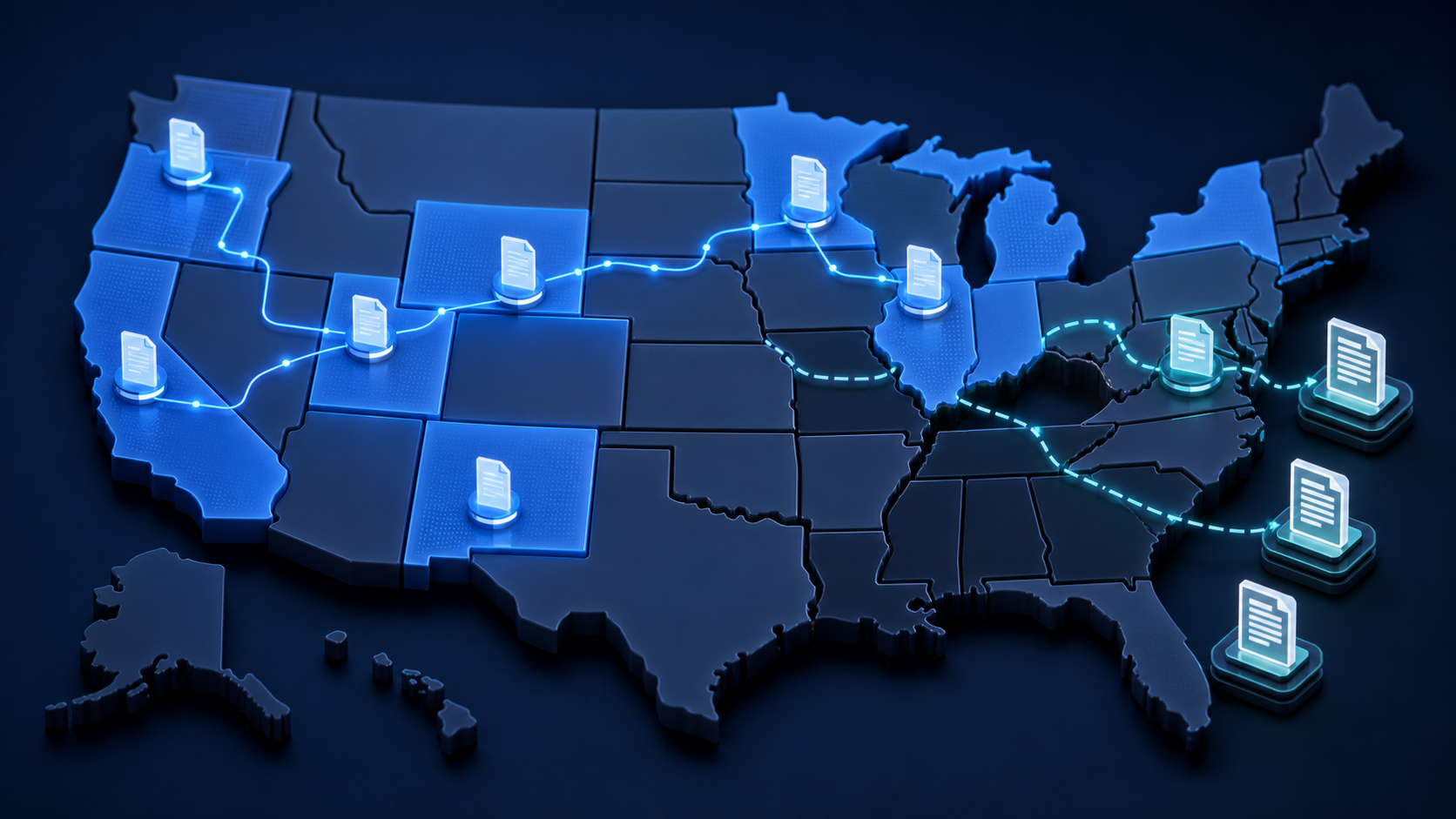
Cobalt Intelligence approaches this as an integration problem rather than a breadth problem. The Court Records API covers New York State and Miami-Dade County, Florida. That is the entire footprint. It is not nationwide, it is not federal, and it does not include PACER. Roughly 80 percent of Cobalt's funder customers file judgments in exactly those two places: New York is the center of alternative lending, and Miami-Dade became the second hub after funders migrated to South Florida. Coverage is demand-driven rather than exhaustive, and additional jurisdictions are on the roadmap, including a planned human-assisted queue for unsupported jurisdictions.
The consequence for a distressed lender: a clean Cobalt court result on a Texas borrower with Texas collateral tells you nothing about your recovery position. It tells you the borrower has no New York or Miami-Dade record. Those are different statements, and treating the first as the second is the error this section exists to prevent. As one funder put it during an evaluation call:
"Most of our clients are not in New York."
That objection is correct and should be answered directly. If your book is national, this is one input among several, not the input. New York is also the only state where Cobalt's Secretary of State, UCC, contractor license, and court records coverage all overlap, which makes it the one jurisdiction where a single provider assembles the full picture.
The product is a data source, not a decisioning engine. It returns what the court published, not a recovery score or a risk grade. Any lender who wants one builds it from their own loss experience.
How Do You Pull New York and Miami-Dade Records Programmatically?
The endpoint is asynchronous by design, because the data is pulled live from the court site rather than served from a cache. You submit a business name, a jurisdiction, and a callback URL, and results are delivered to your callback, typically within 30 to 120 seconds. There is no synchronous mode.
curl -X GET "https://apigateway.cobaltintelligence.com/courtCases?businessName=Example%20Trucking%20LLC&jurisdiction=newYork&callbackUrl=https://your-domain.com/webhooks/court-results" \
  -H "x-api-key: YOUR_API_KEY"
Valid `jurisdiction` values are `newYork` and `miamiDade`, plus `testNewYork` and `testMiamiDade`, which exercise the full request and callback path without consuming credits. Each live lookup costs one credit, the same as a Secretary of State lookup. Returned records include judgment details, case number, case type and division, filing dates, parties, and amounts where the court record includes them.
How Do You Operationalize This Without Slowing the Deal?
Distressed deals close on timelines that do not accommodate a two-week diligence memo. The check has to fit the queue.
What Does the Layered Check Sequence Look Like?
Run the layers in the order that lets you stop early. Secretary of State first, to confirm the entity exists and is in good standing. UCC next, to establish who already holds a perfected position on the collateral. Court records third, to identify judgment creditors and pending claims that could reorder the stack. TIN or EIN verification and OFAC screening alongside. Because the court endpoint is asynchronous, fire it early and let it return while the other checks run, rather than treating it as a blocking step at the end. Our pre-funding litigation check workflow guide walks through the queue design.
Cost behavior shapes adoption more than accuracy does. One funder framed the threshold plainly: if court checks are cheap enough, it becomes worth running them automatically on every application rather than reserving them for deep dives. Another said the moment worth paying for is when you have the state index on court search. At one credit per lookup, the automatic-on-every-file model is affordable for the two covered jurisdictions and unavailable everywhere else.
What Should Never Be Automated From This Data?
Do not automate a decline on a court hit; in this lane the hit is the thesis. Do not automate a priority conclusion, because priority depends on perfection acts the court record does not report. Do not treat a null result as a national clear. Do not infer an amount the record did not publish. The Financial Stability Board's May 2026 assessment of private credit vulnerabilities emphasized the opacity of valuation and exposure data across the sector,[13] and the answer to opacity is documented uncertainty rather than a synthetic score that conceals it. Restructuring activity through 2025 showed the same lesson: outcomes turned on documentation and position, not on early risk grades.[14]
Automate the retrieval. Keep the interpretation with a credit officer who can read a docket, check a perfection date, and write down what the search did not cover.




.jpg)


.png)