


The Quiet Shift in SMB Lending Regulation
For decades, commercial lending existed in a regulatory world separate from consumer credit. Business borrowers were presumed sophisticated. Disclosure requirements were minimal. Licensing was often optional.
That era is ending.
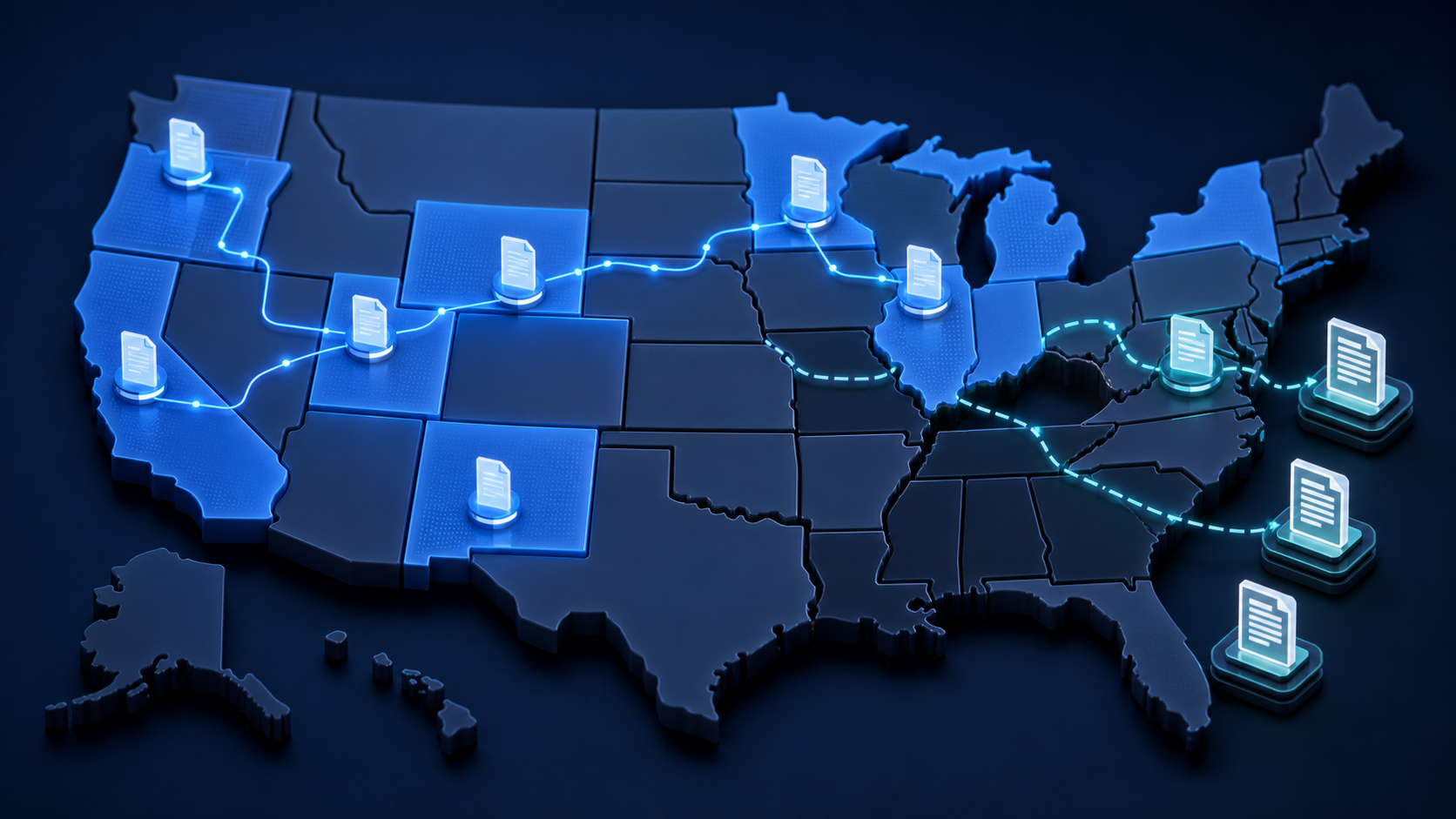
Since California passed SB 1235 in 2018, the first major truth-in-lending law aimed at small business financing,[1] state legislatures have been steadily importing consumer credit concepts into the commercial lending space. The logic is straightforward: a sole proprietor borrowing $50,000 to cover payroll looks more like a consumer than a Fortune 500 company negotiating a revolving credit facility. Legislators have noticed, and 19 states have now enacted some form of small business financial protection law.[2]
The State Patchwork
California and New York have led the charge, but the 19 state laws take several different approaches:
- Truth-in-lending disclosures: California's SB 1235 requires commercial financing providers to disclose APR, total cost of financing, payment amounts, and prepayment policies.[3] New York followed with similar requirements.[4] These disclosures borrow directly from the consumer TILA framework, adapted for commercial products including merchant cash advances, factoring, and revenue-based financing.
- Licensing and registration: Several states have layered on licensing or registration mandates for SMB finance providers. Lenders cannot simply operate across state lines without understanding each state's specific requirements.[5]
- UDAP standards: Some states have extended their consumer UDAP (Unfair and Deceptive Acts and Practices) statutes to cover small business financial products. This creates enforcement risk well beyond simple disclosure violations, including significant penalties and, in some jurisdictions, private rights of action.
The policy rationale is consistent: many "Main Street" businesses are sole proprietorships or closely held entities without in-house finance teams. These borrowers negotiate from a position closer to a consumer than a corporation.
Federal Rule 1071: The Clock Is Ticking
While states write their own rules, the federal government has been building its framework. CFPB Rule 1071, which amends Regulation B to require data collection on small business lending applications, has compliance dates now within operational planning range:[6]
- Tier 1 (highest volume lenders): July 1, 2026
- Tier 2 (mid-volume lenders): January 1, 2027
- Tier 3 (lower volume lenders): October 1, 2027
On November 13, 2025, the CFPB proposed material changes to Regulation B, signaling that requirements may continue evolving even as lenders work toward initial compliance.[7] The rule captures a significant portion of the alternative lending market, and even Tier 3 lenders should be building data infrastructure now.
What MCA and Alternative Lenders Face
Merchant cash advance providers, factoring companies, and revenue-based financing firms are squarely in the crosshairs. Several realities make this segment particularly exposed:
- Product classification is shifting. MCA providers have historically argued their products are not "loans." State legislatures have responded by writing laws that explicitly cover commercial financing transactions, regardless of labeling.[8] The regulatory arbitrage window is closing.
- Multi-state operations are the norm. A typical MCA provider funds businesses in dozens of states. Each of those 19 state laws may apply differently based on borrower location, product type, and transaction size. Compliance is not a single checklist; it is a matrix.[9]
- Speed creates documentation risk. Alternative lenders process thousands of applications monthly with approval timelines measured in hours. That speed becomes a liability when regulators ask to see verification records and entity status confirmations for specific transactions.
The February 19, 2026 Ballard Spahr podcast covered both federal and state acceleration of this trend.[10] The legal community is treating this as a significant, long-term compliance shift.
The Compliance Challenge
The operational challenge for multi-state lenders is not just knowing the rules. It is applying the right rules to the right transactions consistently, at scale, with documentation that withstands scrutiny.
A lender funding businesses in 15 states must track:
- Disclosure requirements varying by state, product type, and transaction size
- Licensing or registration status in each operating jurisdiction
- Entity verification documentation proving the borrower is real and active at time of funding
- Audit trail completeness for every transaction
Smaller lenders face the steepest challenge. They lack the compliance infrastructure larger institutions have built over years. And the patchwork is a moving target, with more states considering similar legislation every session.
Building a Compliance-Ready Operation
Regulators across state and federal levels are converging on a common expectation: if you extended capital to a business, you should be able to prove you verified that entity was real, active, and properly registered at the time of the transaction.
Several principles should guide lenders:
- Automate what can be automated. Manual verification does not scale with regulatory complexity across multiple states and thousands of monthly transactions.
- Build audit trails into the workflow. Compliance documentation should be a byproduct of underwriting, not a separate exercise before an exam. Every verification should generate a timestamped record.
- Centralize compliance data. Multi-state operations require a single view of which rules apply to which transactions. Spreadsheets break down as the patchwork grows.
- Monitor legislative developments. The 19 laws on the books today will not be the final count.
Automated SOS business verification creates the kind of audit trail regulators expect: timestamped proof that a lender confirmed entity status before extending capital, documented at the moment of the decision.
The Bottom Line
The consumerization of small business lending regulation is not a prediction. It is happening now, across 19 states and counting, with federal requirements adding another layer. The lenders who build automated, documented, auditable processes today will operate confidently as regulations expand. Those who wait will scramble to retrofit compliance into operations never designed for it.
The regulatory direction is clear. The question for every VP of Risk and Director of Underwriting is whether their operations are ready.
Cobalt Intelligence provides real-time Secretary of State data and business verification APIs for lenders, fintechs, and compliance teams. Learn more or schedule a demo.




.jpg)


.png)