


Executive Summary: When a VP of Risk needs to verify whether a business is still legally active before funding a deal, two very different tools come up in the conversation: Cobalt Intelligence and Dun & Bradstreet. They both deal in business data, but that is where the similarity ends. Cobalt Intelligence is a primary-source API that pulls real-time entity status directly from Secretary of State databases. Dun & Bradstreet is a secondary-source data aggregator that compiles credit scores, financial risk indicators, and trade payment histories from hundreds of sources into a single profile tied to a D-U-N-S Number. Choosing between them is not an either/or decision for most lending operations. It is a question of which data you need, when you need it, and what you are trying to answer with it.
Why Does the Difference Between Primary and Secondary Data Sources Matter for Lenders?
The single most important distinction between Cobalt Intelligence and Dun & Bradstreet is where the data comes from and how fresh it is at the moment you receive it.
What Is a Primary Source Data Provider?
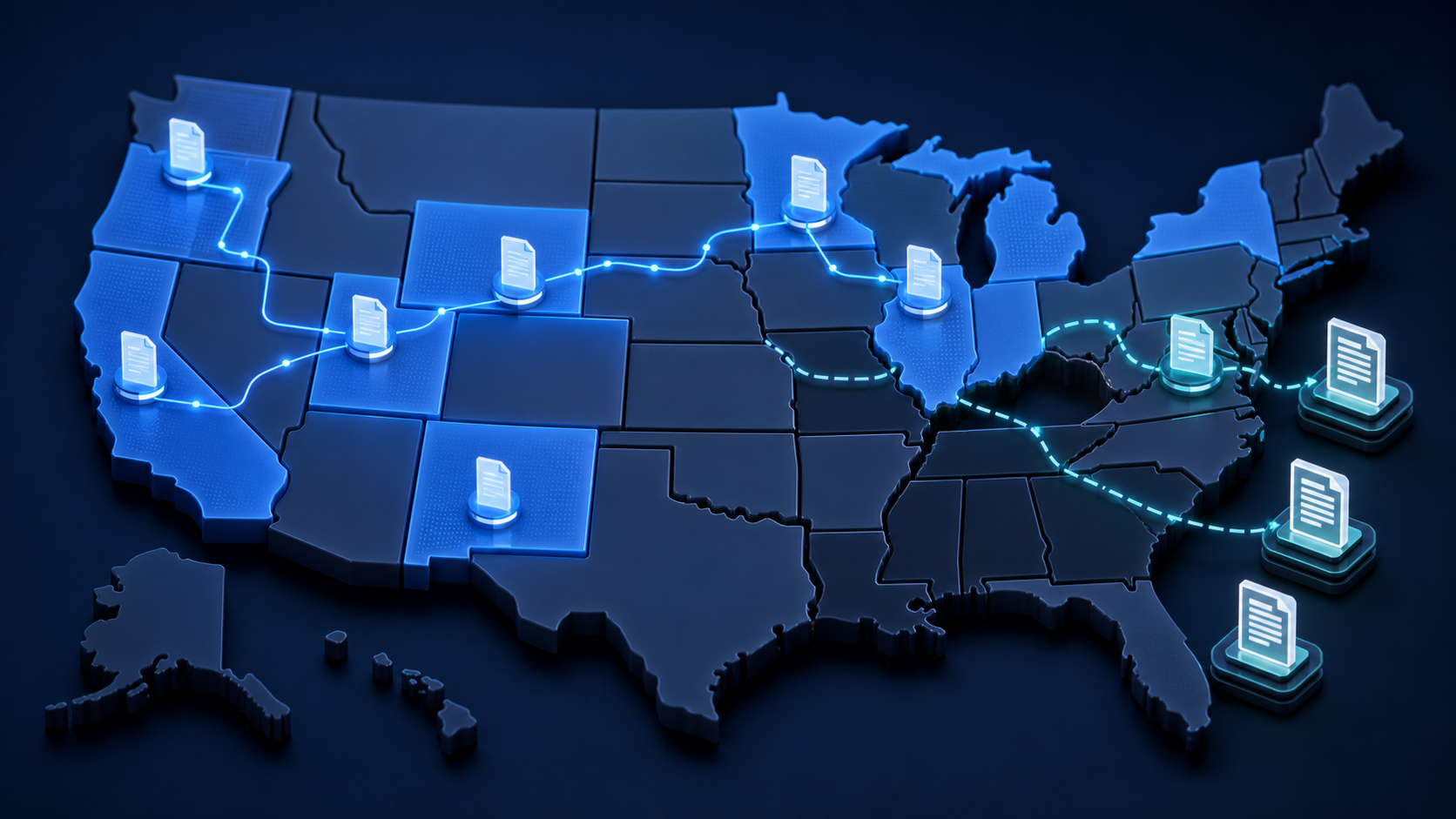
Cobalt Intelligence queries official Secretary of State databases directly with every live API request.[1] When you call the SOS API with `liveData=true`, Cobalt navigates the actual state website, retrieves the current registration record, and returns it to you in a normalized format, typically within 10 to 30 seconds. The data you receive reflects the state's records at the exact moment of the query. If a business was dissolved yesterday, you know today.
This makes Cobalt a primary source provider. The data does not pass through an intermediary database. There is no aggregation delay. The API response includes the raw entity status, filing date, officers, registered agent, and an optional timestamped screenshot of the actual Secretary of State page for audit documentation.[2]
What Is a Secondary Source Data Provider?
Dun & Bradstreet collects data from a wide range of sources, including Secretary of State offices, court records, Yellow Pages, credit inquiries, collection agencies, direct telephone contact with businesses, and trade payment experiences submitted by suppliers.[3] This data is compiled, cleaned, validated through their patented DUNSRight process, and stored in a centralized database covering more than 600 million business records worldwide.[4]
The result is a rich, multi-dimensional business profile. But because D&B aggregates from secondary sources rather than querying primary registries in real time, the data reflects what D&B knew at the time of their last collection cycle, not necessarily what the state registry says right now. Updates to existing D-U-N-S records can take up to five business days to process.[5] For entity status verification in fast-moving lending decisions, that gap matters.
What Data Does Each Provider Actually Return?
Understanding what you get from each provider clarifies when each is the right tool.
What Does Cobalt Intelligence Return?
Cobalt's Secretary of State API returns entity-level verification data pulled directly from state registries:[6]
• Entity status. Active, inactive, dissolved, suspended, revoked, forfeited, and dozens of state-specific variations, all normalized into a consistent format across all 50 states and D.C.
• Filing date. The original date of formation or registration, critical for "time in business" calculations in underwriting.
• Officers and directors. Names, titles, and addresses of individuals listed on the state record.
• Registered agent. Name and address of the entity's registered agent for service of process.
• Physical and mailing addresses. As reported to the Secretary of State.
• Entity type. Corporation, LLC, partnership, and other organizational structures.
• Confidence score. A 0.0 to 1.0 match quality score for automated decisioning.
• Timestamped screenshot. A watermarked image of the actual state website record at the moment of verification.
• UCC filing data. Available in 11 states when requested via the `uccData=true` parameter.
• Related businesses (beta). Other entities linked to the same officers or agents across states.
Cobalt does not provide credit scores, financial statements, trade payment histories, or supplier risk ratings. It is a data source, not a credit bureau.
What Does Dun & Bradstreet Return?
D&B's business reports and API responses include a much broader set of data points:[7]
• D-U-N-S Number. The unique nine-digit identifier assigned to every business in D&B's database.
• PAYDEX Score. A 1 to 100 dollar-weighted payment performance score based on trade experiences reported by suppliers and vendors.[8]
• Credit scores and ratings. Including the D&B Credit Score Class, Financial Stress Score, and Supplier Evaluation Risk rating.
• Financial statements. Revenue, assets, and other reported financials where available.
• Trade payment experiences. Historical records of how the business pays its bills, weighted by recency and dollar amount.
• UCC filings, liens, and judgments. Compiled from public records.
• Corporate linkage. Parent-subsidiary relationships and corporate family trees.
• Beneficial ownership data. Through their compliance verification APIs.
• Risk indicators. Predictive scores for financial stress, delinquency probability, and recommended credit limits.
D&B does not provide real-time Secretary of State queries, timestamped screenshots of state registries, or sub-minute entity status verification from primary sources.
How Does Data Freshness Compare Between Cobalt and D&B?
Data freshness is the core differentiator, and it has direct consequences for lending risk.
How Fresh Is Cobalt's Data?
When you use Cobalt's live mode (`liveData=true`), the data is real-time. The API queries the state's Secretary of State website at the moment of your request. There is no cache, no intermediary database, and no aggregation delay. If a business was administratively dissolved by the state two hours ago, Cobalt's live query reflects that.
Cobalt also offers a cached mode (`liveData=false`) that returns results in under one second, using data refreshed monthly. The recommended approach is a waterfall strategy: check cache first for speed, then follow up with a live query for final verification.[9]
How Fresh Is D&B's Data?
D&B's data freshness depends on several factors: the specific data element, the country, the monitoring subscription, and how frequently D&B's sources update their own records. D&B offers monitoring services with notification frequencies ranging from immediate (event-detected) to hourly, daily, or weekly.[10] However, the underlying data itself, particularly Secretary of State records, financial statements, and trade experiences, is collected on D&B's own cycle.
A critical distinction: D&B's entity information derived from Secretary of State records is not queried in real time. It is collected periodically and stored in D&B's database. When a business's status changes at the state level, there is a lag before that change appears in D&B's records. Creditsafe, a D&B competitor, has specifically called out this lag as a limitation, noting that relying on data that could be weeks or months old can create risk blind spots for lenders.[11]
For a VP of Risk making a funding decision today, the question is straightforward: does the data reflect the state's records right now, or does it reflect what D&B collected during their last update cycle?
When Does D&B Make More Sense Than Cobalt?
D&B is the better tool when you need answers that go beyond entity status verification. There are several scenarios where D&B's breadth of data is irreplaceable.
Where Does D&B Excel?
• Credit scoring and payment history. The PAYDEX score and D&B Credit Score Class are industry standards for evaluating a business's creditworthiness based on how it pays its trade obligations. No real-time SOS API provides this.[12]
• Supplier and vendor risk assessment. D&B's Supplier Evaluation Risk rating helps procurement and trade credit teams evaluate counterparty risk across global supply chains.
• Corporate linkage and family trees. Understanding parent-subsidiary relationships across 200+ countries requires the kind of global corporate hierarchy data that D&B has built over decades.[13]
• Financial stress prediction. D&B's predictive analytics, including Financial Stress Score and delinquency probability, use historical patterns that SOS data alone cannot replicate.
• Global coverage. D&B covers 600+ million businesses across 200+ countries. Cobalt covers all 50 U.S. states and D.C.
• Compliance and beneficial ownership. D&B's Global Compliance Data Packet supports KYC/KYB entity verification with identity, firmographics, principals, and linkage data.[14]
If you need to know whether a business pays its suppliers on time, what its predicted financial stress level is, or how it connects to a parent company in Germany, D&B is the right tool.
When Does Cobalt Make More Sense Than D&B?
Cobalt is the better tool when the question is about entity status and the answer needs to be current, primary-sourced, and audit-ready.
Where Does Cobalt Excel?
• Real-time entity status verification. Is this business active, dissolved, suspended, or revoked right now, according to the state? Cobalt answers this in seconds with live data from the primary source.[15]
• Lending verification workflows. Alternative lenders processing thousands of applications per month need sub-minute verification at scale. Cobalt's credit-based pricing and API-first design are built for high-volume lending pipelines.
• Audit-grade documentation. Timestamped screenshots from the actual state website create a defensible paper trail for compliance examiners. This is not a report generated from a database; it is visual proof of what the state record showed at the moment of verification.
• Fraud signal detection. Dissolved entities, recently formed shell companies, and mismatched officer information surface immediately in real-time SOS queries. The Find Related Businesses feature (beta) adds network-level visibility by surfacing other entities linked to the same officers and agents.
• Normalized 50-state data. Every state uses different terminology. "Active" in California, "Good Standing" in Delaware, "Exists" in Alabama, "Dead" in Ohio. Cobalt normalizes all of these into a consistent format so underwriting rules work the same way regardless of state.
• Speed for deal velocity. When time kills deals, waiting days for a D&B report update is not an option. Cobalt returns live results in 10 to 30 seconds for most states.
"This was an area of the business that was completely manual still... sort of the Achilles heel." Joe Salvatore, Chief Risk Officer, Idea Financial
How Do Pricing Models Compare Between Cobalt and D&B?
The pricing structures reflect fundamentally different business models.
How Does Cobalt Price Its Services?
Cobalt uses a credit-based pricing model. Each API lookup consumes credits from a shared pool:
• SOS Search: 1 credit per lookup
• TIN/EIN Verification: 3 credits per lookup
• OFAC Sanctions Check: 1 credit per lookup
• Full Verification (all 50 states): 3 credits per lookup
Pricing tiers include pay-per-lookup (starter), monthly commitment with discounted per-lookup rates (growth), and custom enterprise pricing with SLA. Pass-through costs for state-imposed fees (Delaware at $15 to $20 per status check) are billed separately at cost. There are no annual contracts required at lower tiers, and test mode is available at no charge for integration development.
How Does D&B Price Its Services?
D&B does not publicly disclose per-lookup API pricing. Their pricing is typically structured as annual subscriptions or enterprise contracts, with the median annual cost reported at approximately $37,500 per year across all services.[16] API access through D&B Direct+ is metered and requires entitlement, with usage tracked and billed according to individual contract terms.[17]
For alternative lenders evaluating cost, the key consideration is total cost per verification decision. A lender running 10,000 verifications per month needs to compare the all-in cost of Cobalt credits against the annual D&B contract cost divided by actual usage volume.
How Should Sophisticated Lenders Use Both Cobalt and D&B Together?
The most effective verification stack treats Cobalt and D&B as complementary, not competing. Each fills a gap the other does not cover.
What Does a Complementary Verification Stack Look Like?
A VP of Risk at a mid-market alternative lender might structure their verification workflow like this:
Step 1: Entity status verification (Cobalt). Before pulling any credit report, confirm the business is legally active. A dissolved or revoked entity does not need a credit score. This takes seconds and costs one credit.
Step 2: Credit and payment history (D&B). For entities that pass status verification, pull the PAYDEX score, credit rating, and trade payment history to evaluate creditworthiness. This provides the financial risk layer that SOS data cannot.
Step 3: Deep verification (Cobalt + D&B). For high-value deals or flagged applications, combine Cobalt's TIN/EIN verification, UCC filing data, and court records check with D&B's financial stress indicators and corporate linkage data.
This approach eliminates wasted spend on credit reports for entities that are not even legally active, while ensuring the lender has both real-time status data and historical financial intelligence for funded deals.
| Dimension | Cobalt Intelligence | Dun & Bradstreet |
|---|---|---|
| Data source type | Primary (live from state websites) | Secondary (aggregated from multiple sources) |
| Entity status freshness | Real-time (seconds) | Periodic collection (days to weeks) |
| Coverage | All 50 U.S. states + D.C. | 600M+ businesses, 200+ countries |
| Credit scoring | Not offered | PAYDEX, Credit Score Class, Financial Stress Score |
| Trade payment history | Not offered | Dollar-weighted supplier payment data |
| Timestamped screenshots | Yes, from actual state website | Not offered |
| Corporate linkage | Related Businesses (beta, U.S. only) | Global parent-subsidiary family trees |
| Pricing model | Credit-based, pay-per-lookup available | Annual subscription, enterprise contracts |
| Integration time | 3 to 5 days typical | Varies, dedicated technical resources often required |
| Best for | Entity status verification, lending workflows, audit trails | Credit assessment, supplier risk, global business intelligence |
| API format | REST, JSON, async callbacks | REST (Direct+) and SOAP (Direct 2.0) |
What Questions Should Each Tool Answer?
| Question | Best Answered By |
|---|---|
| Is this business legally active right now? | Cobalt Intelligence |
| When was this business formed? | Cobalt Intelligence |
| Who are the current officers on the state record? | Cobalt Intelligence |
| Does this business pay its suppliers on time? | Dun & Bradstreet |
| What is this business's predicted financial stress level? | Dun & Bradstreet |
| Is this entity connected to a larger corporate family? | Dun & Bradstreet |
| Can I get a timestamped screenshot for my audit file? | Cobalt Intelligence |
| What is the recommended credit limit for this business? | Dun & Bradstreet |
| Are there other entities linked to these same officers? | Cobalt Intelligence |
What Are the Integration Differences Between Cobalt and D&B APIs?
For CTOs and engineering teams evaluating both tools, the integration experience differs significantly.
How Does Cobalt's API Integration Work?
Cobalt offers a single REST API with JSON responses and standard header-based authentication. A typical integration takes 3 to 5 days. The API supports test mode (no charges) for development, asynchronous callbacks for slow states, and polling with retry IDs for long-running requests.
curl --location 'https://apigateway.cobaltintelligence.com/v1/search?searchQuery=Acme%20Corp&state=delaware&liveData=true&screenshot=true' \
--header 'x-api-key: Your_API_Key'
One API call, one credit, real-time entity data with an optional screenshot. The response format is identical regardless of which state you query.
How Does D&B's API Integration Work?
D&B offers two API platforms: Direct+ (REST) and Direct 2.0 (both REST and SOAP). Integration requires entitlement provisioning, D-U-N-S Number resolution (matching your input to a D-U-N-S), and understanding of D&B's product-specific data layers (compliance, firmographics, monitoring, etc.).[18] The API documentation covers dozens of endpoints organized by use case. Integration typically requires more dedicated technical resources than a single-endpoint REST API.
D&B also recently launched D&B.AI, including MCP servers and agent-to-agent protocols for integrating D&B data into AI agent workflows.[19] This reflects D&B's investment in enterprise AI use cases, which is a different market than high-volume lending verification.
What Should a VP of Risk Consider When Evaluating These Two Providers?
The decision framework depends on what problem you are solving.
If your primary problem is entity status verification for lending decisions, Cobalt Intelligence is the more direct solution. Real-time data from primary sources, audit-grade screenshots, normalized status across 50 states, and credit-based pricing designed for high-volume lending.
If your primary problem is credit risk assessment and supplier evaluation, Dun & Bradstreet is the more complete solution. PAYDEX scores, financial stress indicators, corporate linkage, and 200+ country coverage.
If you need both entity status verification and credit risk assessment, the answer is both. Use Cobalt as the first gate in your verification workflow (is this entity legally active?) and D&B for the credit and financial risk layer (is this entity creditworthy?). This eliminates wasted D&B lookups on entities that are dissolved, revoked, or suspended, while ensuring you have the full picture for entities that proceed to underwriting.
The lending market is moving toward real-time, primary-source verification as a baseline expectation.[20] A third of lenders surveyed in the 2025 LexisNexis Alternative Credit Data Impact Report said alternative data increased their confidence in lending decisions. Three-quarters said it improved portfolio performance, including earlier risk detection. Relying on a single secondary source for all verification needs is increasingly insufficient.
Start a free trial with Cobalt Intelligence to see how real-time SOS verification fits into your existing D&B workflow, or schedule a 15-minute technical demo to walk through the API with your engineering team.




.jpg)


.png)