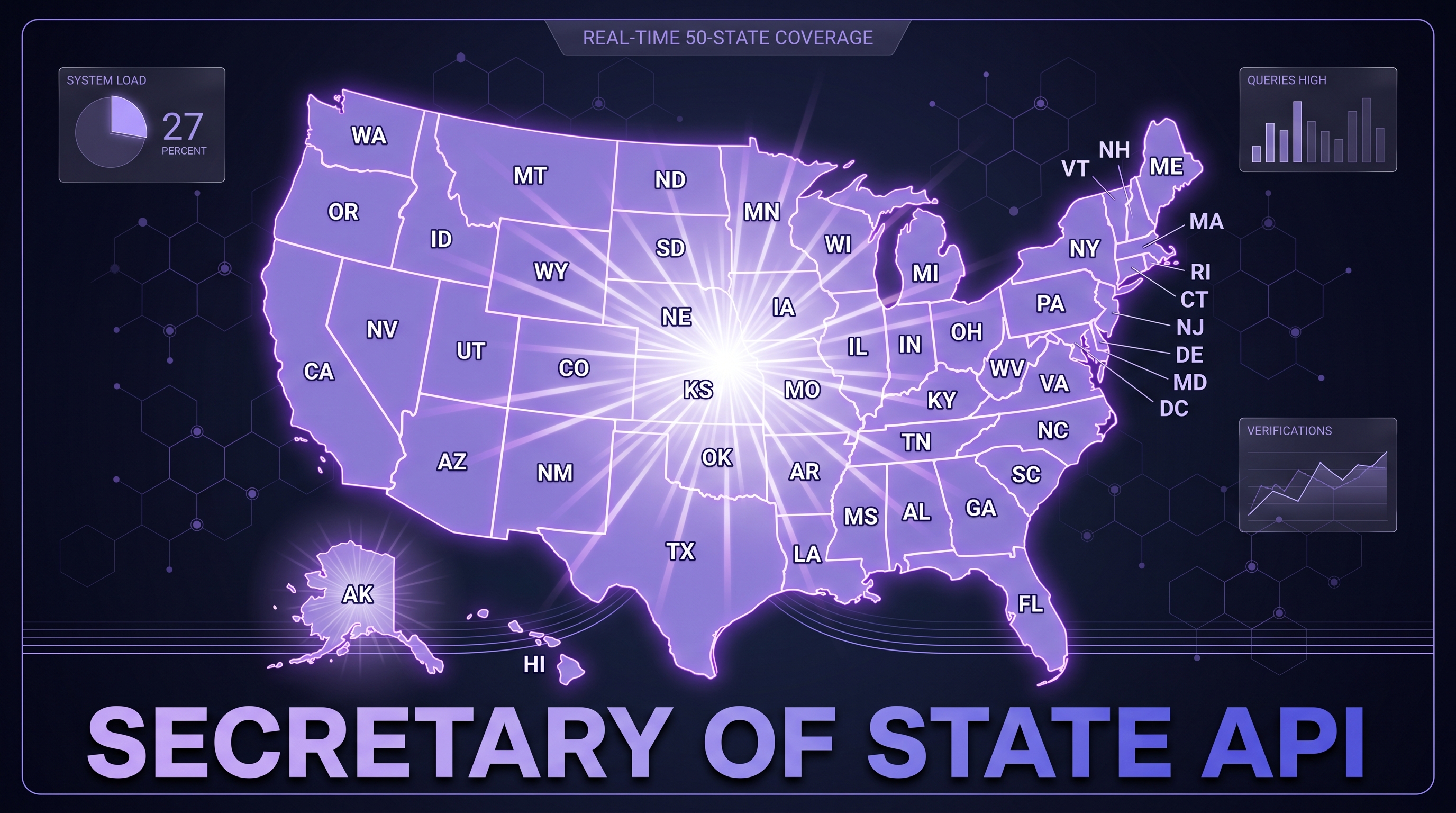
Explore 34 key questions about the Secretary of State API, covering real-time data retrieval, fraud detection, compliance, and integration capabilities.
How high-volume alternative lenders automate thousands of Secretary of State lookups per month, where per-lookup fees compound, and how to size verification ROI.
Oregon SOS is timing out. You have 47 applicants in your funnel. What happens next is an architectural decision you made months ago. Here is what a resilient pipeline does, what a naive one costs you in deal flow and audit exposure, and the checklist your vendor should be able to answer.
Real-time SOS lookups can take 30 seconds to 5 minutes. Synchronous integration blocks onboarding UX. Async webhook architecture is the production pattern. Here is how it works, what breaks, and how to design for the slow-state tail.
Platforms that embed KYB verification as a feature for downstream customers inherit every verification failure at N times the scale. Here is how the architecture has to change when you go from single-tenant underwriting to multi-tenant verification infrastructure.
Every state's Secretary of State registry uses its own status vocabulary. 'Active' in one state is 'Good Standing' in another and 'Current' in a third. Your verification layer either normalizes cleanly or accumulates silent underwriting drift. Here is the data-model playbook.
Pure cache verification is cheap but stale. Pure live-ping is current but slow and expensive. A production waterfall routes each application to the right path based on deal risk, entity lifecycle, and state mix. This post is the architecture playbook.
Access Real-Time Secretary of State Data and Automate your underwriting process. We help Alternative Funders work smarter through AI Technology. Get our FREE AI Tools here
Subscribe to our Newsletter!